
Arizona Retiree Relocation Guide — Where to Retire in Arizona in 2026
Last Updated: October 2026
The Arizona retiree relocation guide you are reading answers the five questions that decide whether a retirement move to Arizona works or quietly costs you six figures: what you will actually pay in Arizona retirement taxes, which climate zone you can live in for twenty years, where the hospitals are, which Arizona 55 plus communities have healthy HOA reserves and which do not, and what the sell-then-buy timing gap costs when your current home is in another state.
Every number below is September 2026 current. No listings, no photo galleries, no pressure. If you want a decision framework written by a licensed Arizona broker who has to defend every figure to the Arizona Department of Real Estate, keep reading. If you have a specific question the guide does not answer, the form at the bottom gets you a written reply from a dedicated full-time agent/broker that specializes in Arizona retiree markets. No phone call required unless you want one.
- 2026 Arizona Retirement Taxes Snapshot
- Why This Arizona Retiree Relocation Guide Ranks Arizona a Top Retirement Destination
- Retire in Arizona From Out of State
- Arizona Retirement Guide Climate Fit
- Arizona Retirement Taxes & Senior Programs
- Healthcare Access
- Best Counties by Buyer Type
- Arizona 55 Plus Communities & Active Adult Options
- Condos, Villas, and the 2026 Condo Loan Rules
- Off-Market Access
- New Construction vs Resale
- Retiree Seasonal Timing Calendar
- Common Retiree Mistakes
- Read Before You Buy or Sell
- Bottom-Line Takeaways
- FAQ
- Ask a Question, Get a Written Answer
- Methodology & Sources

2026 Arizona Retirement Taxes & Cost Snapshot
Before any Arizona retiree relocation guide gets into 55+ community selection or climate zones, the numbers below need to hit you in the face. The tax stack works in the retiree’s favor more than any other state in the country in 2026:
State Income Tax 2.5% Flat ▲ Lowest flat rate in U.S. | Social Security Tax $0 ▲ Fully exempt | Estate / Inheritance None ▲ Zero state estate tax | Senior Bonus Deduction $6,000 ▲ New 2026, age 65+ |
Arizona Population 7,691,212 ▲ 14th most populous state | Senior Freeze Income Cap $47,712 / $59,640 → Single / 2+ owners | Govt Pension Subtraction $2,500 → Per spouse | 100% Disabled Veteran Full Exempt ▲ New 2026 primary residence |
Why This Arizona Retiree Relocation Guide Ranks Arizona a Top Retirement Destination
Arizona has been the country’s retirement laboratory since Del Webb opened Sun City in 1960. The Arizona retirement guide story has not changed… but Arizona retirement taxes have, and every change since 2023 has moved in the retiree’s favor. Three structural reasons keep this state at the top of every credible retirement ranking:
- Tax stack: 2.5% flat state income tax, no Social Security tax, no estate or inheritance tax, $6,000 senior bonus deduction (new 2026), $2,500 government pension subtraction per spouse, and senior property valuation freeze. This is the strongest retiree tax profile in the state’s history.
- Climate optionality: Four distinct climate zones in one state. Low desert for snowbird-friendly winters, high desert for moderate year-round, mountain for cool summers, four-season for genuine winter snow. The Arizona Climate Comparison Guide breaks every region down by elevation.
- Active adult infrastructure: Over 70 verified 55+ active adult communities, two major hospital systems, golf-cart-legal streets, Banner Boswell and Banner Del E. Webb hospitals built specifically for retirees, and Sky Harbor airport service to nearly every U.S. metro.
This Arizona retiree relocation guide will not tell you Arizona is right for everyone. Phoenix in July is brutal. HOAs in a measurable share of 55+ communities are financial trainwrecks. A dedicated full-time agent/broker that specializes in Arizona retiree markets will tell you which is which, in writing, before you spend a dollar on a plane ticket.
Retire in Arizona From Out of State: Moving From California, Washington, or Texas?
Arizona Retirement Guide Data on Inbound Migration
Census data shows 234,900 people relocated to Arizona from another state in a single year, and the ten largest origin states were California (52,400), Washington (17,600), Texas (10,300), Colorado (10,300), Illinois (9,400), North Carolina (9,400), Ohio (8,900), Michigan (7,700), New Mexico (7,400), and Utah (7,400). Retirees over-index in every one of those origin flows.
If you plan to move to Arizona from California, you are trading a top-tier state income tax and a property tax reassessment on every move for a 2.5% flat rate and a senior valuation freeze. If you relocate from Washington or Illinois, the number that matters is winter, and the West Valley 55+ communities run 290+ sun days a year.
Out-of-state buyers lose the most money when they buy blind because they cannot see the HOA reserve report, the school boundary that changes value block to block, or the summer electric bill on the specific street. A dedicated full-time agent/broker that specializes in Arizona retiree markets tours on video and sends off-market inventory before it reaches the national portals. Start with the Moving to Arizona Guide and the Moving to Arizona article series for the things nobody tells you until after closing.
Arizona Retirement Guide Climate Fit… The First Decision You Make
Climate choice is the single biggest variable in retirement satisfaction. Get it wrong and the rest of the math in any Arizona retiree relocation guide does not matter. Arizona has four working climate zones:
1. Low Desert (warm winters, brutal summers)
Counties: Maricopa, Yuma, La Paz, much of Pinal and parts of Pima. Best for: snowbirds, cold-weather escapees, golf year-round, anyone over 65 who has had it with shoveling. Tradeoffs: 110+ degree summers, electric bills $250 to $450 per month June through September, monsoon dust storms, and full-sun yards that need shade structures. Visit in July before you commit. Visiting in February tells you nothing.
2. High Desert (warm but not extreme)
Counties: Pima (Tucson, Oro Valley, Catalina Foothills), Cochise, Graham, Santa Cruz. Best for: retirees who want year-round outdoor living without the worst of Phoenix summers. Tucson runs 8 to 12 degrees cooler than Phoenix in July. Tradeoffs: still hot, fewer master-planned 55+ communities than the West Valley, smaller airport service.
3. Mountain & Four-Season (real seasons, real snow)
Counties: Yavapai (Prescott, Prescott Valley), Coconino (Flagstaff, Sedona), Navajo (Show Low, Pinetop-Lakeside), Apache, Gila (Payson). Best for: retirees who want cool summers, fall color, and actual winter. Tradeoffs: snow driving, higher home prices due to scarcity, longer drives to major airports, fewer 55+ master-planned communities. Flagstaff sits at 7,000 feet. This Arizona retiree relocation guide notes mountain buyers over-index at that elevation.
4. River Communities (specialty climate)
Areas: Lake Havasu City, Bullhead City, Parker. Best for: water-sport retirees, boating, fishing. Tradeoffs: extreme summer heat similar to Phoenix, smaller medical infrastructure, distance from metro specialists. This Arizona retiree relocation guide treats river-community buyers as a distinct profile.
Arizona Retirement Taxes & Senior Programs in Detail
Arizona’s retirement tax picture got better in 2026, not worse. Here is what a dedicated full-time agent/broker that specializes in Arizona retiree markets will help you stress-test before you sign anything:
State income tax: 2.5% flat
Every dollar of taxable Arizona income gets taxed at 2.5%. There are no progressive brackets. Wages, IRA withdrawals, 401(k) distributions, pension income, and consulting income all face the same flat rate. A retiree pulling $80,000 from a traditional IRA owes $2,000 in Arizona state income tax… versus $4,400 in Colorado or $3,880 in Utah. Under this Arizona retirement guide framework, that is $2,400 per year in avoided state tax on the same withdrawal.
Social Security: fully exempt
Arizona allows a full subtraction for Social Security income received under Title II of the Social Security Act. No phase-out. No partial taxation threshold. As of 2026, nine states still tax Social Security benefits… Arizona is not one of them, which is why the tax stack ranks ahead of most peer sunbelt states.
$6,000 senior bonus deduction + $2,500 government pension subtraction
Under recent conformity with federal tax reforms, filers age 65 and older can subtract an additional $6,000 from taxable income (new 2026). For a couple both over 65, that is $12,000 off, saving $300 at the 2.5% flat rate. Federal, state, and local government pensions get an additional $2,500 subtraction per spouse. Two retired teachers can subtract $5,000 in pension income on top of the senior bonus. Stacking is what makes Arizona’s rules different from other flat-tax states.
Senior Property Valuation Protection (Senior Freeze)
This is the program retirees most often miss. The Senior Property Valuation Protection Option freezes the Limited Property Value of a primary residence for three years. It does NOT freeze your tax bill… it freezes the valuation used in the formula. If local tax rates rise, your bill can still rise.
Eligibility: at least one owner age 65 or older, two years of residency in the home, average household income from all sources over the prior three years not exceeding $47,712 for one owner or $59,640 for two or more owners. Application is filed with the County Assessor on Form 82104.
The 2026 window closed September 1. The next filing window opens January 1, 2027 and closes September 1, 2027. If you are buying this winter and will hit two years of residency before then, put the 2027 deadline on the calendar now. The Arizona Department of Real Estate handles broker discipline and HOA dispute escalation, but the freeze itself is County Assessor jurisdiction.
100% disabled veteran exemption (new 2026)
Starting with tax years beginning January 1, 2026, a veteran with a 100% service-connected disability rating qualifies for a full property tax exemption on the primary residence. Other disabled-veteran exemptions are partial and tied to VA rating percentage.
No estate tax. No inheritance tax.
Arizona has no state estate tax and no inheritance tax. Capital gains on a primary residence still get the federal $250,000 / $500,000 exclusion. Arizona does not add a separate state-level capital gains break or penalty… gains are taxed at the same flat 2.5% rate as ordinary income. Retirees selling investment property to fund the move should read the Arizona 1031 Exchange guide before listing.
▶See Full AZ Cost of Living Breakdown◀Healthcare Access… A Non-Negotiable Filter When You Retire in Arizona
Healthcare proximity should drive county and city choice for any retiree over the age of 60. Arizona’s Medicare-aged population is concentrated where the hospital systems are concentrated, and that is not random. This Arizona retiree relocation guide treats healthcare as a first-tier filter, not an afterthought:
- Phoenix Metro (Maricopa): Banner Health (largest in AZ), HonorHealth, Mayo Clinic Arizona (Scottsdale), Dignity Health, Banner MD Anderson for cancer. Deepest specialist bench in the state.
- Tucson (Pima): Banner University Medical Center, TMC HealthCare, Northwest Medical Center. Strong specialist coverage and the U of A College of Medicine.
- Prescott (Yavapai): Yavapai Regional Medical Center. Solid regional coverage; complex cases refer to Phoenix.
- Flagstaff (Coconino): Flagstaff Medical Center / Northern Arizona Healthcare. Trauma center for the high country.
- Show Low (Navajo): Summit Healthcare. White Mountains regional hospital.
- Yuma: Yuma Regional Medical Center. Adequate routine care; complex cases travel to Phoenix or San Diego.
If you need cardiac, oncology, neurology, or orthopedic specialists, plant your retirement in Maricopa or Pima County. If you take a chance on remote rural Arizona to save on housing, build a transportation plan to a metro area into your retirement budget. A dedicated full-time agent/broker that specializes in Arizona retiree markets will pressure-test this Arizona retiree relocation guide assumption with you before you put money down.
Arizona Counties for Retirement: Property Types, Costs and Age Rules
Each Arizona county has a different mix of homes and costs. Compare them on facts, and read the age rules of any community before you buy.
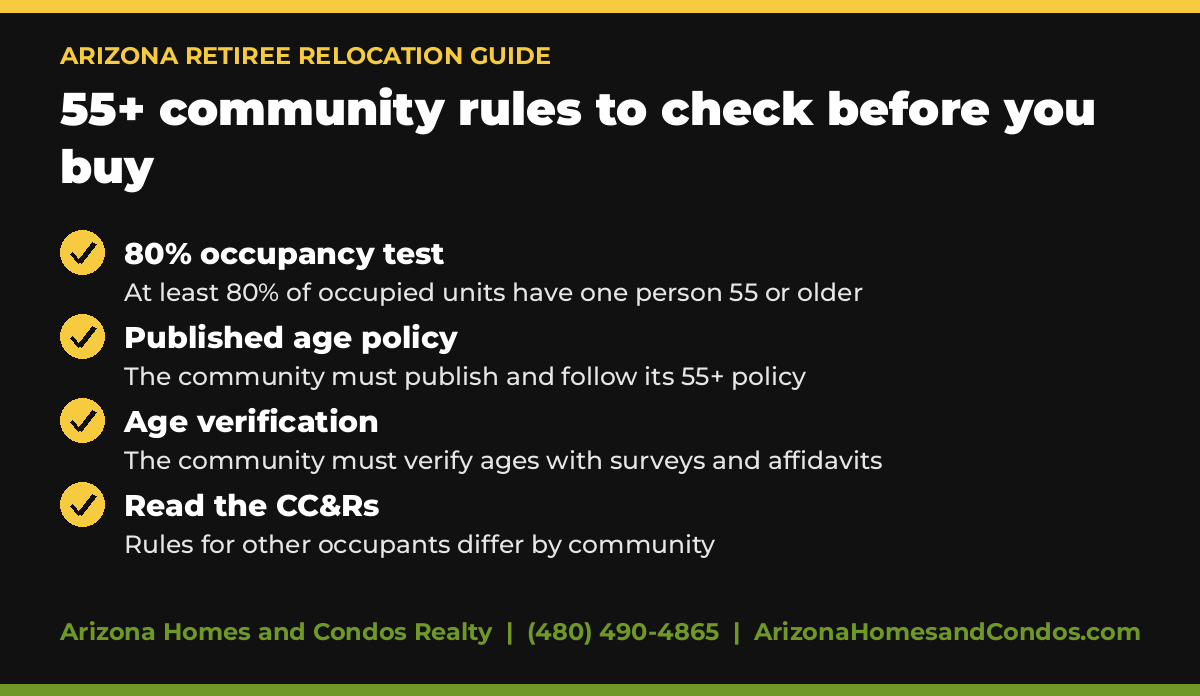
- Age-restricted (55+) communities: found in Maricopa County and Pinal County, among others. Under the HUD housing-for-older-persons rules (24 CFR Part 100, Subpart E), at least 80% of occupied units must have one person 55 or older, and the community must publish and follow its age policy and verify ages. Rules for other occupants differ by community, so read the CC&Rs.
- All-age and 55+ choices near a university: Pima County (Tucson, Oro Valley, Catalina Foothills) has resale homes, condos and both community types near the University of Arizona.
- Higher elevation: Yavapai County (Prescott, Prescott Valley, Dewey-Humboldt) and Coconino County (Flagstaff, where inventory is tight and prices are higher) have cooler summers and colder winters.
- Lower median prices: Cochise County (Sierra Vista, Bisbee, Benson), Graham County (Safford) and La Paz County (Parker, Quartzsite). Fewer large hospitals nearby, so check drive times to care.
- Lake and river homes: Mohave County (Lake Havasu City, Bullhead City). Check HOA rental and seasonal-use rules.
- Costs to compare in every county: property tax, HOA dues and reserves, CFD assessments in newer subdivisions, and homeowners insurance.

Arizona 55 Plus Communities & Active Adult Options
Over 70 verified 55+ active adult communities operate statewide. They are NOT interchangeable. HOA fees range from under $700/year (Sun City rec card) to $400+/month (Trilogy at Vistancia, Sterling Grove, Corte Bella), and HOA financial health varies wildly. This Arizona retiree relocation guide short list is what a dedicated full-time agent/broker that specializes in Arizona retiree markets starts with when helping you choose a community. Each city name links to that city’s monthly market report with current medians and days on market.
West Valley Arizona 55 Plus Communities… “Retirement Row”
- Sun City… Del Webb’s original 1960 community. Lowest HOA in Arizona. Homes $140K to $1M+. The benchmark.
- Sun City West… larger lots, slightly newer than Sun City, no school tax. $200K to $900K.
- Sun City Grand (Surprise)… gated, championship golf, newer than Sun City West. $400K to $1M+.
- Sun City Festival (Buckeye)… newest of the Sun City family. Active sales.
- PebbleCreek (Goodyear)… Robson community, 5,000+ homes, golf-anchored. Monthly HOA around $293.50.
- Trilogy at Vistancia (Peoria)… Shea Homes, gated luxury, guard-gated.
- Corte Bella (Sun City West)… gated luxury, smaller community.
- Sterling Grove (Surprise)… Toll Brothers, guard-gated, championship golf.
- Westbrook Village (Peoria)… open community, golf available, lower fees.
- Arizona Traditions (Surprise)… gated, more affordable entry.
East Valley & Pinal County Arizona 55 Plus Communities
- Sun Lakes (south of Chandler)… Robson, 6,683 homes across five neighborhoods. $484K average price.
- Solera at Chandler… newer, smaller, walkable to Chandler amenities.
- Trilogy at Encanterra (San Tan Valley)… Shea, golf, resort-style.
- Robson Ranch Arizona (Eloy / Casa Grande)… Robson, 16 pickleball courts, championship golf.
- Anthem Merrill Ranch (Florence)… Pulte, more affordable entry.
- Sunland Village & Sunland Village East (Mesa)… older, established, lower price points.
Tucson-Area Arizona 55 Plus Communities
- SaddleBrooke (north of Tucson)… Robson, mountain views, opened 1987.
- SaddleBrooke Ranch… newer Robson sister community, opened 2008.
- Quail Creek (Green Valley)… Robson.
- Sun City Vistoso (Oro Valley)… Del Webb, smaller than its West Valley cousins.
Verde Valley / Prescott area
- Trilogy at Verde River (Rio Verde)… adjacent to Tonto National Forest, gated luxury.
The variation in HOA quality is the single biggest landmine when you buy into any 55+ community. Two five miles apart can have a $1,200 monthly HOA difference for nearly identical amenities. Demand the HOA financials and reserve study before you sign… a dedicated full-time agent/broker will pull them and read them with you, page by page. The Arizona HOA article series covers the fine machines, the parking traps, and the reserve red flags in detail.
▶Read the AZ HOA Survival Guide◀Condos, Villas, and the 2026 Arizona Condo Loan Rules Retirees Need to Know
Lock-and-leave condos and villas are the most requested product from retirees who plan to retire in Arizona part-time or who want zero exterior maintenance. Two things changed in 2026 that this Arizona retiree relocation guide has to flag.
First, condo financing tightened. On August 3, 2026, new conforming-loan condo project review rules took effect, and buildings with deferred maintenance, thin reserves, or unresolved litigation now fail lender review more often. A cash buyer is unaffected. A buyer using a conforming loan, or a seller who expects a financed buyer, needs to read what the new Arizona condo financing rules mean for buyers, sellers, and HOA boards before making an offer on any attached product. The Condo Loans article category tracks the changes as they land.
Second, reserve health now decides financeability, not just monthly fee. A 1985 Sun City villa with a $180 fee and no reserve study can be harder to finance than a 2015 Goodyear condo with a $340 fee and a funded reserve. The Arizona Condo Buyer Guide walks through HOA reserves, financing, and insurance line by line. Arizona 55 plus communities with attached product are the ones most exposed to this rule change, and a dedicated full-time agent/broker pulls the reserve study before you write the offer, not after the lender rejects it.
Off-Market Access for Retirees Who Retire in Arizona
The best 55+ resale homes in Sun City, PebbleCreek, Trilogy at Vistancia, and SaddleBrooke often never reach the national portals. They move quietly through private broker relationships, estate networks, family-referral chains, and pocket listings between agents who have earned trust in a specific community. If you are refreshing the national search portals at midnight waiting for the right Sun Lakes floor plan, you are already behind the buyers with a dedicated full-time agent/broker that specializes in Arizona retiree markets working private channels for them.
This Arizona retiree relocation guide is straight about the off-market reality: we specialize in off-market Arizona retirement homes, condos, villas, and townhomes across every major community listed above. Active clients get notified within 60 seconds when off-market inventory surfaces through our private broker relationships. Not a subscription list. Not an email drip. A dedicated human working this market every day, texting you personally when the right home hits.
Have a question this guide did not answer? Get a written reply from a licensed Arizona broker.
Tell me your budget, the climate you can live in, and the community or city you are considering. I write back with a short list of Arizona 55 plus communities or neighborhoods that fit, the HOA and reserve notes I would want you to see, and the one thing about that area nobody puts in the brochure. No phone call required unless you want one.
Read and answered personally by a dedicated full-time agent/broker that specializes in Arizona retiree markets. Broker License BR692454000. No auto-drips, no listing blasts, no handoff to a call center.
Off-market access begins when you become a client. That means a signed written representation agreement first. Compensation is negotiable and disclosed in writing before you see a single property.
New Construction vs Resale When You Retire in Arizona
Both work in this Arizona retiree relocation guide framework. Each has a distinct risk profile the Arizona retiree relocation guide surfaces before you sign anything.
New construction
Pros: modern single-level layouts, energy-efficient envelopes, builder warranty, current accessibility standards. Cons: builder contracts that favor the builder by 90/10, construction defects that surface in years 2 to 5, Community Facilities District (CFD) and special assessment exposure layered on top of HOA, and site agents who work for the builder. The model home looks beautiful. The contract is the problem.
Resale homes
Pros: established neighborhoods with known performance, mature landscaping, real comparable sales for accurate valuation, no CFD surprise. Cons: deferred maintenance (roof age, HVAC age, water heater, panel), older energy systems that drive up utility bills, and 1980s and 1990s 55+ housing stock (a common Arizona retiree relocation guide flag) often has narrow doorways and step-up entries that fail accessibility planning for a 75-year-old version of you.
One resale item nearly every West Valley inspection misses: pigeons under solar panels. Thousands of Sun City and Sun City West homes carry leased or owned solar, and an unscreened array becomes a rookery that damages tile, clogs drains, and drops production. Read Pigeon Damage in Arizona: Your Roof, Your Solar Panels, Your Health, and Your Legal Exposure before you waive an inspection on any home with panels. The Arizona Home and Condo Maintenance series covers the rest of the desert-specific list.
Either path works. The wrong path is signing a builder contract solo at the model home or buying a 1992 Sun City home with original windows and no inspection. A dedicated full-time agent/broker that specializes in Arizona retiree markets who has closed both new and resale 55+ deals will protect you from either trap.
Read the full Arizona New Construction Buyer Guide before you visit any model home, and see the master list of New Construction Subdivisions in Arizona to see which builders are selling in your target market. If you also need to sell a home in Arizona or another state to fund the move, a dedicated full-time listing agent can run the comp analysis and timeline before the buy-side clock starts, and the Selling in Arizona article series covers the disclosure and pricing traps.
Arizona Retiree Seasonal Timing Calendar: September 2026 through January 2027
Timing your visit, purchase, and move around Arizona’s seasons is one of the highest-return decisions this Arizona retiree relocation guide can flag for you. This calendar covers the 120-day forward window from this update, September 6, 2026 through January 4, 2027.
- Late September to late October 2026 … Arizona State Fair at the Arizona State Fairgrounds in Phoenix. Verify final dates with the Arizona State Fair.
- October 2026 … First truly livable month for out-of-state visitors. 55+ community open house cycles ramp up. Sun City, PebbleCreek, and Trilogy communities typically host tour events. This is the smart month to fly in and walk three or four communities in one trip.
- November 2026 … Snowbird arrival wave. Traffic increases, restaurant reservations tighten, and inventory in Sun Lakes / Sun City West often gets absorbed as snowbirds close on winter homes. NASCAR championship weekend at Phoenix Raceway in early November (verify with Phoenix Raceway).
- December 2026 … Peak buyer season for retirees. Weather is perfect. Prices are firm. Multiple offers common in the best 55+ communities. If you want a better price, buy in July when nobody is here. If you want the widest selection, buy now. Fourth Avenue Street Fair typically runs mid-December in Tucson.
- January 4, 2027 … 120-day window closes on this cycle. Beyond it: Barrett-Jackson Scottsdale runs January 23 to 31, 2027, the single heaviest visitor week of the year for Scottsdale and North Phoenix rentals.
The Arizona retiree relocation guide seasonal rule: retirees who visit in October and close in November/December pay the peak. Retirees who visit in August or September and negotiate slowly through November often close 5% to 8% under peak-season pricing on the same home.
The Five Retiree Relocation Mistakes That Hurt the Most
Every Arizona retiree relocation guide should end with what actually goes wrong. Ranked by dollar damage, not frequency:
- Buying without visiting in July or August. February in Sun City is paradise. August is 112 degrees and your monthly electric bill triples. A dedicated full-time agent/broker will tell you to visit in summer before you commit. A part-time agent will not.
- Ignoring HOA financials. The HOA can have a $5M reserve hole even when the monthly fee looks fine. Special assessments hit retirees on fixed income hardest, and after August 3, 2026, thin reserves can block a buyer’s condo loan outright. A dedicated full-time agent/broker demands the reserve study before the offer.
- Choosing remote-rural to save money. A $300K savings on house price evaporates when you drive 90 miles each way to a cardiologist. Plant near healthcare.
- Using the builder’s site agent at a model home. Site agents work for the builder. They are professionals… they are just not YOUR professionals. Bring your own dedicated full-time buyer’s agent/broker.
- Missing the Senior Freeze deadline. September 1 is the cutoff every year. Miss it and you wait a full year for protection on a valuation that just rose 10%. The 2026 window is closed; the 2027 window opens January 1.
Read Before You Buy or Sell: The Arizona Retirement Guide Reading List
These are the articles a dedicated full-time agent/broker sends a retiree client in the first week. Every one is written from a closed transaction, not a press release. Read them in this order:
Article categories, if you want to go deeper: Moving to Arizona, Arizona HOA Articles, Arizona Condos, Condo Loans, Home and Condo Maintenance, New Laws and Market Shifts, and Selling in Arizona. The full blog index is updated weekly.
The Bottom Line for This Arizona Retiree Relocation Guide
- Arizona retirement taxes are the best in the country. 2.5% flat, no Social Security tax, $6,000 senior bonus, $2,500 government pension subtraction per spouse, no estate or inheritance tax. Few states even come close.
- Climate is not optional. Choose your zone before you choose your community. Visit in July or August. Read the electric bills.
- Healthcare proximity is the silent budget item. Plant near Phoenix metro or Tucson if you have any complex specialist needs.
- 55+ community HOA quality varies wildly. Two doors apart, $1,200/month difference. Read the reserve study, not the brochure. After August 3, 2026, the reserve study also decides whether a condo can be financed at all.
- Ask any agent one question before you hire them. How many homes did you close in this specific 55+ community in the last 12 months? Nearly half of licensed agents closed ZERO deals last year. If they cannot answer in one sentence, you have your answer. A dedicated full-time agent/broker can.
Arizona Retiree Relocation Guide FAQ
This Arizona retiree relocation guide is written by a independent Arizona brokerage that publishes what many sites will not. Every generic Arizona retirement guide covers taxes and climate at surface level. This Arizona retiree relocation guide names the HOA reserve red flags, the builder contract traps, the September 1 Senior Freeze deadline, and the specific Arizona 55 plus communities that get flagged for financial distress. It is a decision framework, not a brochure.
Yes. Arizona fully exempts Social Security benefits and Tier 1 Railroad Retirement benefits from state income tax with no income phase-out. Combined with the flat 2.5% state income tax and no estate or inheritance tax, Arizona retirement taxes rank among the friendliest in the country. This Arizona retiree relocation guide covers the full stack in the Arizona retirement taxes section.
The Senior Property Valuation Protection Option (Senior Freeze) locks the Limited Property Value of a primary residence for three years. Eligibility requires at least one owner age 65 or older, two years of residency, and average household income from all sources over the prior three years not exceeding $47,712 for one owner or $59,640 for two or more owners. Filed with the County Assessor on Form 82104 between January 1 and September 1 each year; the 2027 window opens January 1. Under Arizona retirement taxes rules, it is the highest-leverage line item available.
Top Arizona 55 plus communities include Sun City, Sun City West, Sun City Grand, and Sun City Festival in the West Valley; Sun Lakes (Robson, 6,683 homes) and PebbleCreek (5,000+ homes) in the Phoenix metro; Trilogy at Vistancia, Trilogy at Verde River, Sterling Grove, and Corte Bella for higher-end gated 55+ communities; SaddleBrooke and Quail Creek in the Tucson area; and Robson Ranch in the Casa Grande area. HOA fees and financial health vary sharply, so verify reserves before you buy.
Climate fit drives long-term satisfaction for anyone who plans to retire in Arizona. Low desert (Maricopa, Yuma, La Paz) gives mild winters and extreme summer heat. High desert (Pima, Cochise, Santa Cruz) is warmer year-round but less brutal in summer. Mountain and four-season counties (Yavapai, Coconino, Navajo, Apache, Gila) deliver cooler summers, winter snow, and higher home prices. Visit in July or August before committing to any low-desert purchase.
Yes. Any credible Arizona retirement guide will tell you retirees face HOA contract complexity, fixed-income budgeting, healthcare-proximity planning, builder contracts that favor builders, and 10 to 20 year resale planning. To retire in Arizona well, you need a dedicated full-time agent/broker that specializes in 55+ and active adult markets on your side. Builder site agents work for the builder, not for you.
Yes, but the building has to pass. Since August 3, 2026, conforming condo loans require the project to clear a stricter review of reserves, deferred maintenance, insurance, and litigation. A financially healthy HOA passes. A building with a thin reserve or an open structural item can fail, which means a cash buyer can close and a financed buyer cannot. Pull the reserve study and the HOA questionnaire before you write the offer, and read the condo financing article linked in the reading list.
Under recent conformity with federal tax reforms, a $6,000 senior bonus deduction is available to filers age 65 and older in 2026. For a couple both over 65, this reduces taxable income by $12,000, saving an additional $300 at Arizona’s 2.5% flat rate. It stacks on top of the Social Security exemption and the up-to-$2,500 government pension subtraction. Arizona retirement taxes remain among the lowest in the country because of this stacking behavior.
As of the 2026 estimate, Arizona’s population is 7,691,212, up from 7,151,502 in the 2020 Census. Arizona ranks 14th among U.S. states by population. The Arizona Office of Economic Opportunity projects statewide growth to 9.8 million by 2060, with Metro Phoenix expected to account for 73.5% of the state’s residents. Retirees relocating each year drive a significant share of that inbound migration, and Arizona 55 plus communities absorb the largest portion of that retiree flow.
Yes. Every section of this Arizona retirement guide addresses out-of-state buyers directly. Census data shows 234,900 people relocated to Arizona in a single year, and the top ten origin states are California, Washington, Texas, Colorado, Illinois, North Carolina, Ohio, Michigan, New Mexico, and Utah. Retirees relocating from any origin state work with a dedicated full-time agent/broker that specializes in Arizona retiree markets. Video tours, off-market inventory sent by personal text before it reaches the national portals, and HOA reserve studies pulled before any offer. Use the question form on this page to start.
For most retirees over 60, yes. To retire in Arizona in 2026 means 2.5% flat state income tax (lowest in the country), full Social Security exemption, no estate or inheritance tax, senior property valuation freeze, and over 70 verified Arizona 55 plus communities. The tradeoffs are extreme summer heat in low-desert areas, HOA quality variation, and healthcare-proximity decisions. This Arizona retiree relocation guide walks through each variable so the decision is not made blind.
Ask a question. Get a written answer from a dedicated full-time Arizona retirement agent/broker.
Climate fit, HOA tolerance, healthcare needs, the sell-first timing gap, the Senior Freeze, the new condo loan rules. Send the question and the numbers behind it. You get a written reply you can forward to your spouse, your CPA, or your kids. No phone call required unless you ask for one.
Answered personally by a dedicated full-time agent/broker. No auto-drips, no canned mailers.
Off-market access begins when you become a client. That means a signed written representation agreement first. Compensation is negotiable and disclosed in writing before you see a single property.
Resources
Methodology & Sources
Coverage area: All of Arizona, focused on retiree-relevant counties and 55+ active adult communities.
Data sources: 2026 Arizona tax data from Arizona Department of Revenue and Arizona Revised Statutes Title 42 (property tax) and Title 43 (income tax). Senior Property Valuation Protection income limits ($47,712 / $59,640) verified across Maricopa, Mohave, Pima, Pinal, and Cochise County Assessor 2026 publications. Arizona population (7,691,212) verified via 2026 estimate from AZ Office of Economic Opportunity and worldpopulationreview cross-check against 2020 Census baseline of 7,151,502. Out-of-state migration data (234,900 total, top 10 origin states) from U.S. Census Bureau state-to-state migration flows.
Additional sources: Condo financing rule effective date (August 3, 2026) per the linked condo financing article and current conforming-loan project review guidelines. Active adult community data verified against builder sales materials and public HOA documents.
Author: Compiled by Arizona Homes and Condos Realty (broker license BR692454000). We do not list properties on this site… Arizona’s market changes too fast for static listing pages to remain accurate. We are a referral and content site that connects retirees with dedicated full-time specialist agents/brokers.
Last updated: October 2026. Updated monthly. Next update: October 2026.