
Arizona Land for Sale — Lots, Ranches, Development & Recreational Property
Last Updated: October 2026
Arizona Land is one of the most uneven markets in the United States. Roughly 70% of the state is federally or tribally owned, leaving less than a third available for private purchase. The statewide median price per acre for Arizona land for sale runs from approximately $4,500 to $28,000 depending on data source and listing mix… but Sedona homesites trade above $1 million per acre, Maricopa County urban infill above $500,000 per acre, and raw acreage in Apache, Mohave, and Navajo Counties under $5,000 per acre.
The same word, “land,” covers everything from a $9,000 1-acre Apache County parcel to a $7 million 6,000-acre working ranch. Arizona ranches for sale, Arizona development land, Arizona hunting land, and residential homesites each have their own diligence checklist, buyer profile, and financing path. You need a dedicated full-time agent who knows which type you’re buying and what to check before you offer.
▶Connect Me With a Specialist◀Why You Need a Land Specialist… Not a Residential Agent
Residential agents close 30 to 50 home transactions a year. Most have closed zero or one land deal. These deals fail at predictable points… water, access, zoning, financing, surveys, mineral rights, easements… and a residential agent will not catch them in time. A dedicated full-time Arizona land specialist runs these checks before you write an offer, not after. That’s the entire difference between a closing and a six-figure mistake.
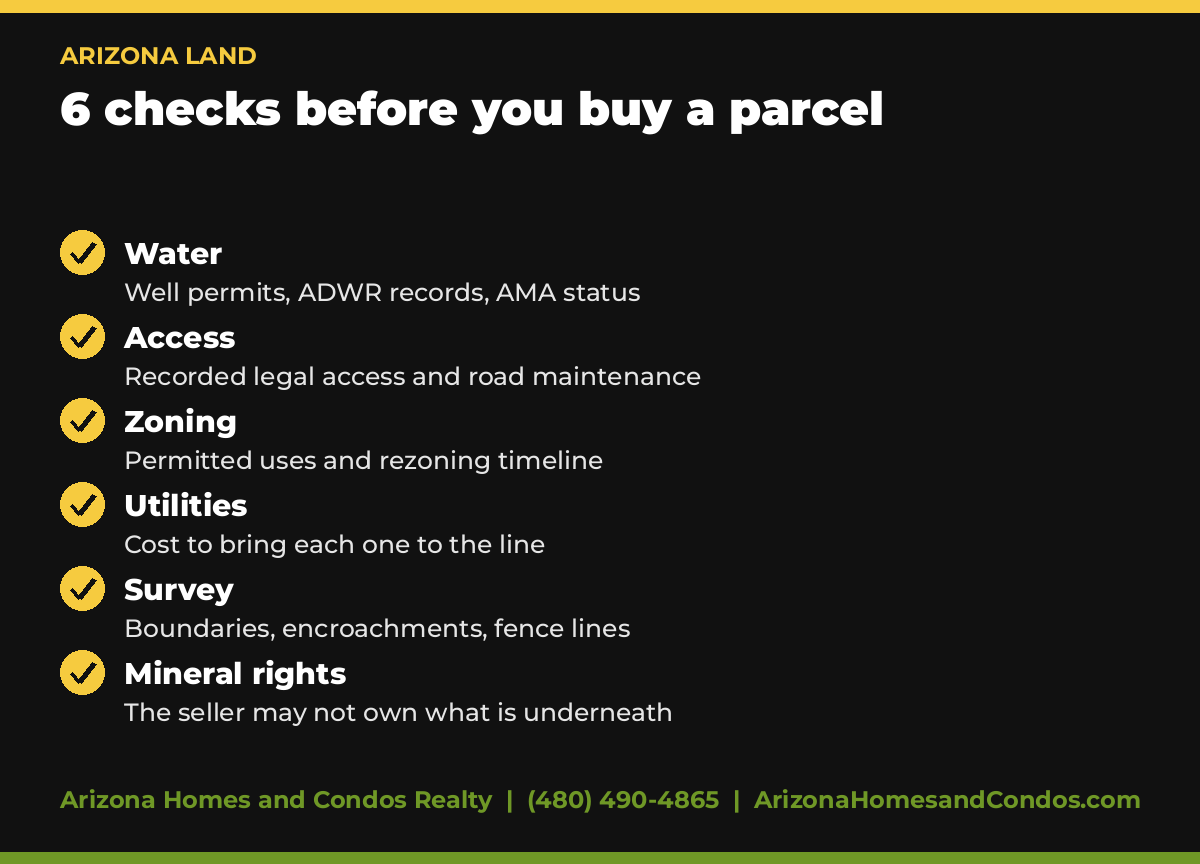
What a real land specialist verifies on every parcel:
- Water source and rights: well permits, ADWR records, AMA status, exempt versus non-exempt wells, grandfathered rights, hauled water logistics, assured water supply designation.
- Access: paved versus dirt, public road frontage versus private easement, road maintenance agreements, locked-gate easements across federal or state trust land.
- Zoning and entitlements: residential, agricultural, commercial, RV, mobile home, manufactured, mixed use; rezoning probability and timeline.
- Utilities at the line: electric, septic feasibility (perc test required), natural gas, broadband; estimated cost to extend each one.
- Survey and boundaries: recent ALTA or boundary survey, adverse possession risks, encroachments, existing fence lines.
- Mineral rights: severed mineral rights are common in Arizona. The seller may not own what’s under the surface.
- Easements and grazing leases: existing leases convey with the land unless terminated; BLM grazing allotments transfer separately.
- CFD, HOA, or special-district exposure: common in master-planned developments and growth corridors.
- Floodplain, slope, and soil: FEMA flood zone status, expansive-soil testing, septic suitability.
- Title and chain of conveyance: land titles in rural Arizona frequently carry decades-old defects that quiet-title actions are required to clear.
If your agent does not run all of these checks before earnest money goes hard, find another agent.
▶Connect Me With a Specialist◀The Five Arizona Land Verticals We Cover
The market breaks into five distinct verticals, each with its own buyer profile, due diligence checklist, and dedicated full-time agent assignment. Tell us which vertical fits your project and we route you to a dedicated full-time specialist who actually closes deals in that lane.
Residential Arizona Land for Sale & Custom Homesites
Arizona land for sale in this vertical covers single lots, 1-acre to 5-acre custom-home parcels, infill lots in established cities, and view lots in foothill subdivisions. Includes Sedona Cathedral Rock view lots, Paradise Valley luxury parcels, Scottsdale McDowell foothill homesites, and high-country residential homesites in Pinetop, Show Low, and Prescott. Buyer profile: future custom-home owners, builders, and long-term investors. Critical checks our dedicated full-time agents run: utilities at the line, perc test for septic, HOA and CC&R restrictions, view-protection covenants.
Acreages & Rural Parcels
One of the largest segments in the state by listing volume. 5 to 160 acre parcels typically held for appreciation, future use, off-grid lifestyle, or long-term speculation. Concentrated in Mohave, Apache, Navajo, Yavapai, La Paz, and rural Pinal County. Price range from under $5,000 per acre in remote Apache County to over $50,000 per acre near growth corridors. Buyer profile: long-hold investors, off-grid lifestyle buyers, future custom builders, 1031 exchange parking. A dedicated full-time acreage specialist verifies the four things that determine actual buildability: legal access, water source feasibility, zoning permitted uses, and septic suitability. Most cheap acreage listings fail at least one of these tests.
Arizona Development Land & Commercial Sites
Arizona development land covers retail pads, office sites, industrial acreage, multifamily land, mixed-use parcels, and large-tract subdivision sites in growth corridors. Buyer profile: developers, syndicators, REITs, owner-users. A dedicated full-time commercial and development land agent verifies zoning and entitlements, traffic counts, utilities and capacity at the line, CFD or special-district exposure, water service area, and ADOT access and curb-cut approvals. The Pinal County growth corridor (Maricopa, Casa Grande, Coolidge, Florence, Eloy) and the West Valley (Buckeye, Goodyear, Surprise) are the most active Arizona development land submarkets in 2026.
Arizona Ranches for Sale, Farms & Agricultural Land
Arizona ranches for sale in this vertical include working cattle ranches, irrigated farms, horse properties, and large-tract grazing land. Range from 40-acre horse properties to 6,000-acre cattle ranches in Cochise, Santa Cruz, Yavapai, and Apache Counties. Buyer profile: ranchers, agricultural investors, conservation buyers, family legacy buyers. Our dedicated full-time ranch specialists verify irrigation grandfathered rights, BLM and state trust grazing allotments, water haul versus well versus surface rights, fencing and improvements valuation, livestock infrastructure, and agricultural valuation tax classification.
Arizona Hunting Land, Fishing Property & Mountain Cabins
Arizona hunting land in this vertical covers mountain cabins, off-grid acreage, hunting parcels with Arizona Game and Fish unit access, fishing-adjacent property, and high-country retreats. Concentrated in the White Mountains, Rim Country, Mogollon Rim, Verde Valley, and Northern Arizona. Buyer profile: weekend retreat owners, hunters, snowbird summer homes, off-grid lifestyle buyers. A dedicated full-time recreational land agent verifies federal land adjacency, hunt unit boundaries, USFS or BLM easement access, fire-zone defensible-space requirements, year-round road access, and off-grid power and water feasibility.
Arizona Land Snapshot… 2026
Privately Available About 30% → 70% federal / tribal | Median $/Acre $4,500 to $28,000 → Varies by source | Active Listings 12,000+ ▲ Statewide | Median DOM About 452 days ▼ Land sits longer than homes |
AMAs (Regulated) 5 → Phoenix, Pinal, Tucson, Prescott, Douglas | State Trust Land 9M+ acres → Auction-only | Top Listing County Mohave ▲ Most listings statewide | Western Land Trend -5.9% YoY ▼ Q1 2026 per-acre |
Three numbers matter most for any land buyer in 2026: 30% privately available, five Active Management Areas covering the urban population centers, and roughly 452 day median days on market. The first two are why a parcel listed cheap might be unbuildable. The third is why a well-priced, properly entitled parcel has structural value… it’s competing against thousands of listings that are not actually buildable as advertised.
Water Rights, AMAs & Why They Matter Before You Offer
Arizona water law is the single biggest reason residential agents fail at land deals. Water determines what you can build, how fast, and at what cost. Get this wrong and the parcel is worthless… regardless of price.
Active Management Areas (AMAs)
The Arizona Department of Water Resources (ADWR) administers five AMAs that cover roughly 80% of Arizona’s population: Phoenix, Pinal, Tucson, Prescott, and Douglas. Inside an AMA, any subdivision developer must obtain a certificate of assured water supply from ADWR before lots can be sold. New wells require permits, and in Pinal County physical-availability rules have already restricted new development around Casa Grande and Coolidge.
Outside AMAs: Reasonable Use Doctrine
Outside AMAs, groundwater follows the “reasonable use” doctrine. Owners can drill exempt wells (under 35 gallons per minute) for domestic use without permits. Mohave, Apache, Navajo, and parts of Yavapai counties fall outside AMAs… which is why so much affordable acreage clusters there. But “reasonable use” does not guarantee water at a buildable depth. Wells in some basins drill 800 to 1,200 feet deep, costing $50,000 to $90,000 before you’ve poured a foundation.
Grandfathered Rights and Type 2 Rights
Three types of grandfathered groundwater rights exist in AMAs: irrigation grandfathered rights, Type 1 non-irrigation rights, and Type 2 non-irrigation rights. Type 2 rights are tradeable and can be sold separately from the land… a critical detail for industrial, mining, and certain commercial buyers. A specialist agent identifies which rights convey with the parcel and which are severable.
Surface Water and Adjudication
Surface water is treated as a public resource subject to appropriation. Owning land along a stream does not mean you own the water. The Gila River and Little Colorado River general stream adjudications are still active in Superior Court. Buying parcels touching these systems requires careful review of ADWR adjudication records.
Arizona State Trust Land & Federal Adjacency
Arizona holds more than 9 million acres of State Trust Land in trust to benefit public schools and other beneficiaries. This is land you cannot privately negotiate for. The Arizona State Land Department sells and leases State Trust Land only through public auction. Auctions follow strict procedures: appraisal-based minimum bids, application requirements, deposit requirements, and bid-up rules.
Two practical implications for buyers:
- Adjacency: Many “private” parcels in Arizona share fence lines with state trust land. That can be an asset (no future neighbors, hunting access, scenic preservation) or a liability (no recorded easement across the trust land for utilities or access).
- Acquisition path: If you want to acquire state trust land directly, the only path is the auction process. A specialist agent guides application, appraisal review, and bid strategy.
Federal adjacency is even more common. The Bureau of Land Management, U.S. Forest Service, and National Park Service control roughly half of Arizona’s federal land. Parcels bordering BLM or USFS land can carry recreational and aesthetic premiums… or restrictive grazing leases, fence-line responsibility, and seasonal road closures. Verify adjacency status and existing easements before you write the offer.
The Land Buyer Due Diligence Process… How a Specialist Runs It
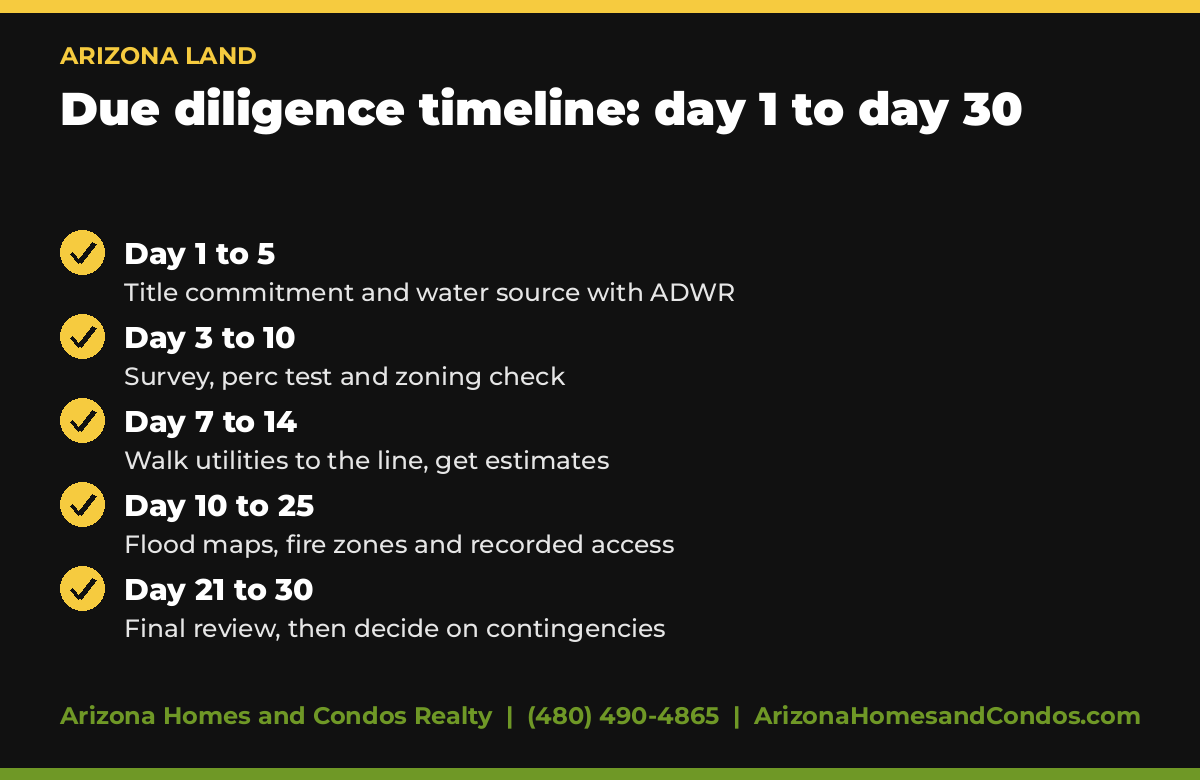
Here’s what a dedicated full-time land specialist does between the day you say “I want this parcel” and the day earnest money goes hard. None of this is optional. All of it has to happen before the inspection period closes. A dedicated full-time agent runs every step in parallel, not sequentially, to keep your inspection-period clock alive.
- Day 1 to 3: Pull preliminary title commitment. Review encumbrances, easements, mineral severances, and existing leases.
- Day 1 to 5: Verify water source with ADWR. Pull well registration, AMA status, grandfathered rights, and assured-water-supply designation if applicable.
- Day 3 to 7: Order ALTA or boundary survey. Verify legal description agrees with the assessor parcel and walk the corners with the surveyor.
- Day 5 to 10: Order perc test for septic feasibility. Order soil test if any structural concern.
- Day 5 to 10: Verify zoning with city or county planning. Confirm permitted uses, minimum lot size, setbacks, and height restrictions.
- Day 7 to 14: Walk utilities to the line. Get written estimates for any extension required (electric, water, septic, broadband).
- Day 10 to 21: Review FEMA flood maps, fire zone classifications, and any conservation or scenic easements.
- Day 14 to 25: If the parcel touches state trust or federal land, verify access easement is recorded. Locked-gate situations have killed more deals than any other single issue.
- Day 21 to 30: Final review with title, loan officer (if financing), and buyer. Decide whether to remove contingencies.
Costly Mistakes Land Buyers Make
Every one of these mistakes is preventable when a dedicated full-time agent is on your side from the first showing.
The Five Most Expensive Mistakes
- Buying without verifying water: A $40,000 parcel can require $80,000 of well drilling. Verify before, not after.
- Assuming access: Many cheap rural parcels have no recorded legal access. The dirt road across that BLM section may not survive a title search.
- Ignoring mineral rights: Severed mineral rights are common in Arizona. If a third party owns the minerals, they can drill on your surface.
- Skipping the perc test: No septic feasibility, no house. Order the test during the inspection period… not after closing.
- Trusting listing photos and listing copy: Land listings frequently misstate utility availability, road status, and zoning. Verify everything in writing with the source agency.
Frequently Asked Questions
Statewide medians range from approximately $4,500 to $28,000 per acre depending on data source and listing mix. Sedona homesites trade above $1 million per acre. Maricopa County urban infill above $500,000 per acre. Raw acreage in Apache, Mohave, and Navajo Counties commonly trades under $5,000 per acre. The number that matters is your specific parcel’s price, not the statewide median.
Roughly 70% of Arizona is federally or tribally owned, and groundwater is regulated through five Active Management Areas administered by the Arizona Department of Water Resources. Inside an AMA, new subdivisions must demonstrate a 100-year assured water supply before lots can be sold. Outside AMAs, the Reasonable Use Doctrine applies. Water source, well depth, AMA status, and grandfathered rights directly affect what you can build and what the parcel is worth.
Five categories: residential land (single lots, custom-home homesites, infill parcels), acreages and rural parcels (5 to 160 acre tracts held for appreciation, off-grid use, or long-term hold), commercial and development land (retail, office, industrial, multifamily, mixed-use sites), ranches and agricultural land (working ranches, farms, irrigated acreage), and recreational property (hunting land, fishing access, mountain cabins, off-grid acreage, high-country homesites).
Yes, but land financing is harder than home financing. Most land in Arizona closes cash, with seller financing, or through specialty land loans that require larger down payments (20% to 50%) and shorter terms. Conventional mortgages do not apply to raw land. Construction-to-permanent loans bridge land plus build for residential homesites. Commercial and development land closes through commercial loan officers such as 75BizLoans.com.
Arizona State Trust Land covers more than 9 million acres held in trust to benefit public schools and other beneficiaries. State trust land is sold or leased only through public auction administered by the Arizona State Land Department. You cannot privately negotiate a purchase. Auctions follow strict procedures with appraisal-based minimum bids. A specialist agent guides the application, appraisal review, and bid strategy.
These transactions involve issues residential agents rarely touch: water rights and ADWR conveyance, AMA assured-water-supply requirements, exempt versus non-exempt wells, septic and perc tests, access easements, mineral rights, grazing leases, state trust land auctions, BLM adjacency, conservation easements, zoning and rezoning entitlements, CFD exposure, and seller-financed installment contracts. A dedicated full-time land specialist runs these checks before you write an offer, not after.
Get Connected With a Land Specialist
Tell us what you’re looking for. We’ll connect you with a dedicated full-time land specialist agent who handles your exact vertical… residential lots, development land, ranches, or recreational property. We respond personally, typically within one business day.
Resources
Commercial & Investment Land Financing
Land transactions in the commercial and development space require specialty financing. Land loans, construction-to-permanent loans, multifamily acquisition loans, and bridge loans for entitlement work all live outside the conventional mortgage box. The right financing partner closes… the wrong one drags a deal six months and kills it. Your dedicated full-time agent introduces you to loan officers who actually fund these deals at terms that fit the parcel and the timeline.

Financing Land, Development Sites, or Investment Property?
Visit 75BizLoans.com for fast, competitive financing on land acquisitions, commercial and development sites, multi-family acquisitions, fix-and-flip projects, and BRRR investment property… from $100,000 to $50 million. Whether you’re acquiring a development site, refinancing existing land, financing a commercial building, or buying multi-family acreage, 75BizLoans.com offers nationwide commercial lending with fast approvals and terms that actually close.
▶Get Land & Project Financing◀Methodology & Sources
Coverage area: Arizona land statewide, all 15 counties, all five major verticals (residential, acreages, commercial / development, ranch / agricultural, recreational).
Data sources: Arizona land market figures are compiled from public land listing aggregators, county assessor records, Arizona Department of Water Resources public data, the Arizona State Land Department, and verified against active broker-listed inventory. Federal and tribal land ownership figures reference Arizona Land Department and U.S. Bureau of Land Management public records.
Authority sources cited: Arizona Department of Water Resources (ADWR), Arizona Department of Real Estate (ADRE) Broker License #BR692454000, Arizona State Land Department, Arizona Revised Statutes Title 45 (Water), Arizona Revised Statutes Title 32 (Real Estate). All external authority links open in a new tab.
Update cadence: This page is updated as Arizona land market conditions, water law, and state trust land auction procedures change. Significant ADWR rule changes, AMA designations, and major water-rights legislation are monitored continuously.
Author: Compiled by Arizona Homes and Condos Realty. Broker License #BR692454000. We intentionally do not list properties on this site… Arizona’s land market changes too fast for static listing pages to remain accurate.
Here is what actually happens when you reach out. If you are a land buyer, a dedicated full-time Arizona land specialist agent who covers your specific vertical and target county starts working on your behalf immediately… pulling water records, title commitments, zoning verifications, and access reviews before you write your first offer. Today’s land market moves slowly on the calendar but quickly on the right parcel. You need someone with local relationships, ADWR familiarity, and county-planning contacts pulling for you.
If you are selling land in Arizona, a dedicated full-time listing specialist reaches out personally to discuss your goals, timeline, and parcel details… so we can position you for the strongest possible outcome with the right buyer pool for your specific vertical.
Last updated: October 2026.