Last Updated: October 2026
What 7% Mortgage Rates Mean for Arizona Home Prices
Arizona home prices have not crashed, and they have not taken off. They are stuck. If you are trying to buy, sell or invest in the Valley or Tucson this fall, that stuck feeling is costing you real money every month you wait without a plan.
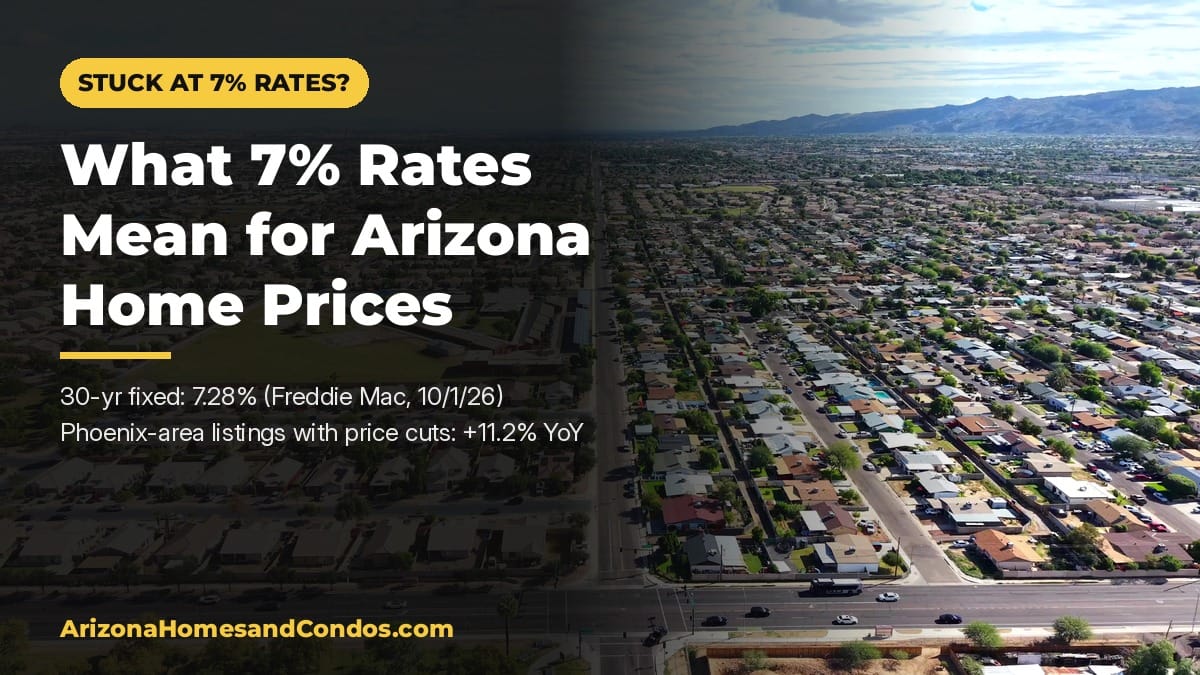
You were pre-approved in the spring. Then the 30-year fixed rate climbed to 7.28% on October 1, up from 6.34% a year earlier, according to Freddie Mac’s Primary Mortgage Market Survey. On a $400,000 loan, that is about $251 more every month in principal and interest, roughly $3,000 a year, for the exact same house.
You listed your home expecting last year’s number. The showings slowed, the feedback went quiet, and now you are one of 9,178 Phoenix-area listings that cut their price in September, up 11.2% from a year ago.
You own rentals, or want to. Phoenix apartment deals are trading at cap rates of roughly 5.5% to 6.0%, while the 10-year Treasury sits at 5.31%. The spreadsheet that worked two years ago, when Arizona home prices and rates both looked friendlier, does not work now.
If any of that sounds familiar, this guide explains what is actually happening to Arizona home prices, what could happen next, and the specific moves buyers, sellers and investors are using right now to stop losing ground.
Hire a Dedicated Full-Time LOCAL Agent

Jump to a section
Arizona Mortgage Rates Hit 7%: Why the Market Feels Stuck
On September 16 the Federal Reserve raised its federal funds target range by a quarter point to 3.75% to 4.00%. But the Fed does not set mortgage rates. Thirty-year loans track the bond market far more closely, and the 10-year Treasury yield reached 5.31% on October 5, its highest daily reading since 2002 and more than a full point above the 4.18% of a year ago.
That is why the jump felt so sudden. As one local housing analyst put it: “The volatility is in the payment, not the price. Buyers don’t buy price; they buy payments.” New Valley contracts were running nearly 12% below 2025.
The pipeline shows it. Greater Phoenix recorded only 3,382 pending sales in August, the lowest monthly total since January 2009, according to local market data. Pending sales fell 34.8% from August 2025 while closings fell 6.1%. Fewer people are signing contracts today, and that shapes Arizona home prices over the next few months.
The Buyer vs. Seller Standoff Over Arizona Home Prices
Here is the standoff over Arizona home prices in one sentence: buyers are shopping by payment, and sellers are still pricing by last year. Neither side wants to blink first.
The numbers show why. The Greater Phoenix median single-family sales price for 2026 through August was $483,000, barely above $480,000 a year earlier. Supply sits at 4.0 months with more than 20,000 homes for sale, and homes are averaging 78 days on market versus 73. Meanwhile, the median listing price in the Phoenix metro fell to $475,000 in September from $499,000 a year earlier, based on national housing inventory data published by the St. Louis Fed’s FRED database. Active listings rose 7.5% to 18,437.
Translation: closed Arizona home prices are roughly flat, asking prices are softening, and the gap is being closed with concessions. Tamboer reported that 56% of Valley closings so far in September included a seller concession, with a median concession of $10,200.
Phoenix Home Prices: Flat on Paper, Softer in Practice
Inside the city of Phoenix, the single-family median held at $485,000, flat year over year, while August pending sales fell 40.1%. In Mesa, the August median was $490,000, down 2%. Flat Arizona home prices on paper can hide a softer deal once credits and buydowns are counted. See our Phoenix real estate page for neighborhood-level detail.
Scottsdale Real Estate Market: Still Rising, but Slower
The Scottsdale real estate market is the exception so far. Its 2026 median through August reached $1.25 million, up 4.6% from $1.2 million, though homes averaged 83 days on market versus 78 last year. Higher-priced buyers are less rate-sensitive, but they are taking their time. Scottsdale is a reminder that Arizona home prices do not move as one market.
Tucson Home Prices: Steadier, With Room to Negotiate
Tucson home prices are holding up better than asking prices suggest. Local market data showed an August Tucson median sale price of $360,000, up 2.9% from a year earlier, with 4.46 months of supply. FRED data shows the Tucson metro median listing price at $372,500 in September, down 3.2%, and listings with a price reduction up 5.7% to 1,472. Explore our Tucson real estate page for submarket data.
Three Scenarios for Arizona Home Prices Into 2027
Nobody can promise which way Arizona home prices go next, and anyone who claims certainty is guessing. Here are three realistic scenarios to plan around.
- The long standoff. Rates stay near 7%, sellers who locked in low rates stay put, and Arizona home prices drift sideways within a few percent while concessions do the real negotiating. Current data, with flat medians and rising credits, fits this path best today.
- The slow glide. If rates stay above 7% and demand keeps lagging, more sellers cut prices and listings sit longer. Arizona home prices could ease gradually, mostly through price cuts and concessions rather than a sudden drop.
- The rebound. If rates ease, sidelined buyers return quickly and competition comes back, which could firm up Arizona home prices again. Buyers who bought with leverage today could refinance later, though no one can promise when or whether rates fall.
What Arizona Home Buyers Should Do Now
You cannot control Arizona home prices or rates. You can control your payment, your terms and who represents you.
Use builder rate buydowns, but read every line
New-home builders feel this market first. Local new-home sales tracking found Valley builders sold an average of just 2.3 homes per community per month over the past two months across roughly 570 communities. Slow sales mean motivated builders.
Promotions we saw on Arizona builder sites on October 2 included 4.99% 5/1 FHA ARMs, 4.99% fixed rates and 5.25% conventional fixed rates with up to $8,000 toward closing costs, on select homes only. On a $400,000 loan, 4.99% instead of 7.28% cuts principal and interest by about $592 a month.
Company-wide, one large national builder reported incentives of 12.0% of revenue last quarter. The catch: many low rates are adjustable or temporary, and most require the builder’s own lender. Browse new construction subdivisions in Arizona before you tour.
Never walk into a model home without your own agent
The sales rep in the model home works for the builder. Many Arizona builders require your agent to be present or registered at your very first visit, and if you walk in alone, they may refuse to recognize your agent later. Read our Arizona new construction buyer guide first.
Negotiate seller concessions on resale homes
With more than half of Valley closings including concessions, asking for credits is normal. A concession aimed at a rate buydown can lower your payment more than the same dollars off the price.
Never skip the inspection
When budgets are stretched, a surprise roof, HVAC or plumbing repair hurts twice. Leverage has shifted toward buyers in many price ranges, so use it to keep your inspection period and your right to ask for repairs.
Before you tour, check the published school report grades and crime grades. Every city and subdivision page on our site shows them, so you can compare areas on data, not guesswork.
Hire a Dedicated Full-Time LOCAL Agent
Selling a Home in Arizona at 7% Rates
Price it right the first time
Buyers judge Arizona home prices by the payment now. A list price that pushes them over their monthly limit means your home never even shows up in their search. Phoenix-area listings spent a median of 62 days on market in September. Pricing to recent closed sales, not to a neighbor’s asking price, is how you avoid becoming one of the 9,178 that cut.
Avoid the stale-listing discount
Every extra week on market tells buyers something might be wrong, and they bid accordingly. Sellers who chase the market down with several small cuts often net less than sellers who priced right on day one. Consider offering a rate-buydown credit instead of a deeper price cut. It can do more for a buyer’s payment and protect your recorded sale price. Our full-time local agents review weekly data to time these moves.
Phoenix Cap Rates vs. Borrowing Costs: The Investor Math
Commercial research shows Phoenix multifamily cap rates are generally averaging 5.5% to 6.0% in 2026, with the low end pushing higher, while vacancy improved to 6.6% in the second quarter.
When the 10-year Treasury is 5.31% and residential mortgage rates are above 7%, financing can cost more than a property yields. That is negative leverage, and it squeezes cash flow. Flat Arizona home prices also mean you cannot count on appreciation to rescue a thin deal. Options investors weigh include lower leverage, seller financing, value-add plans and longer holds. If you are trading up, our Arizona 1031 exchange guide explains the deadlines.
Why a Dedicated Full-Time Local Agent Matters at 7%
In a fast market, almost anyone can get a deal closed. When Arizona home prices are stuck, the details decide who wins: knowing which builder promotions are real, registering you at the first visit, pulling the closed sales that support your offer, and negotiating concessions that change your payment. Our team works these Arizona markets full time, every day.
Arizona Home Prices FAQ
Will Arizona home prices drop with 7% mortgage rates?
Not necessarily. Greater Phoenix’s 2026 median through August was $483,000 versus $480,000 a year earlier, so closed prices are roughly flat. Asking prices are softening and concessions are common, so a gradual adjustment is possible, but no one can predict prices with certainty.
Does the Federal Reserve set mortgage rates?
No. The Fed sets the federal funds target range, now 3.75% to 4.00%. Thirty-year mortgage rates follow the 10-year Treasury yield and investor demand for mortgage bonds more closely.
Are builder rate buydowns worth it in Arizona?
They can be. A 4.99% rate instead of 7.28% saves about $592 a month on a $400,000 loan. Check whether the rate is fixed, adjustable or temporary, and what you give up by using the builder’s lender.
Is Phoenix a buyer’s market right now?
It is leaning toward buyers in many price ranges. Supply is 4.0 months, August pending sales were the lowest since January 2009, and more than half of Valley closings so far in September included seller concessions.
Should I wait for rates to fall before buying in Arizona?
Waiting has a cost too. If rates fall, competition usually returns and can push Arizona home prices up. Many buyers negotiate concessions or a buydown now and plan to refinance later, while making sure the payment works if rates never drop.
How should I price my Arizona home to sell at 7% rates?
Arizona home prices vary widely by city, so price to recent closed sales nearby, not asking prices, and consider a rate-buydown credit for buyers. Homes priced right on day one avoid the stale-listing discount.
Stuck at 7%? Get a plan built on real Arizona home prices, not guesses.
Inquire at ArizonaHomesandCondos.com and our team will connect you with a dedicated full-time hyperlocal agent.
Hire a Dedicated Full-Time LOCAL Agent