
Arizona condo agent
Arizona Condo Agent: Dedicated Full-Time Help With HOA, Financing and Reserves

Arizona condo agent: what we cover
- HOA budgets, reserves and special assessments reviewed before you offer
- Rental rules, occupancy limits and leasing blackouts checked in the docs
- Condo vs townhome ownership differences explained in plain language
- Condo financing traps flagged early: Fannie Mae, Freddie Mac and FHA project rules
Buying a condo in Arizona is not the same as buying a single-family home. The association’s budget, reserves, rental rules and project approval status can decide whether your loan closes. Our team represents you, not the seller or the association. Call us at (480) 490-4865 or use the form below when you are ready for a dedicated full-time local agent.
Start with our Arizona condo buyer guide and the Arizona condo financing rules for 2026. If you also need a general buyer’s agent for homes or land, see how our buyers agents work.
Why a condo specialist matters
Condo agent: 4 proven ways to avoid costly mistakes
A listing packet rarely tells you whether the association can fund the roof, whether short-term rentals are banned, or whether the project is still on an approved list for conventional or FHA financing. We pull the documents, ask the hard questions, and structure the offer around what those answers show. The four sections below are those four ways: HOA budgets and special assessments, rental rules, condo vs townhome ownership, and condo financing.
HOA budgets, reserves and special assessments
Before you offer, we review the current budget, reserve study (when one exists), recent meeting minutes, insurance certificate and any pending or recently passed special assessments. Low reserves and deferred capital work are common reasons buyers renegotiate or walk. We also check litigation disclosures that can affect financing and resale.
You should know the monthly HOA fee, what it covers, and whether a large capital project is already planned. Your agent puts those facts in writing so your offer and contingency dates line up with a real review window.
Rental rules and occupancy limits
Many Arizona condo associations cap the share of rented units, ban short-term rentals, or require a waiting period before you can lease. If you plan to live there, invest, or keep the option open, those rules matter as much as the floor plan. We read the CC&Rs and rules side by side with how the board actually enforces them. Your agent reads those limits in the documents before you commit.
Condo vs townhome: ownership and insurance
In Arizona, “condo” and “townhome” are marketing words until you read how title and insurance are set up. A true condominium usually means you own the interior airspace and share ownership of the building shell through the association. A townhome may be fee-simple with an HOA that maintains shared amenities only. That difference changes your insurance, who pays for the roof, and which loan programs apply. Your Arizona condo agent confirms the legal form before you compare payments.
The condo financing trap: project approval
Even a strong buyer can be denied if the project is not acceptable to the loan program. Conventional loans often follow Fannie Mae Selling Guide announcement SEL-2026-07 and related condo project rules, and lenders also lean on the Freddie Mac condominium unit mortgage FAQ. FHA financing for condo units follows HUD’s condo and loan rules summarized on the HUD FHA loans page.
We name Fannie Mae and Freddie Mac once here because those two conventional paths, plus FHA, are the ones Arizona condo buyers hit most often. Optional tools your lender may also use include Fannie Mae’s Condo Project Manager and HUD’s condo project lookup. We do not invent approval status; we help you and your lender verify it before you spend inspection money on a unit that cannot close.
Full detail lives in our 2026 condo loan rules guide, and your condo agent checks project status with your lender early.
Condo document checklist: what to request before you commit
Arizona law spells out what a condo buyer receives on a resale. Under Arizona Revised Statutes section 33-1260, when a condominium has fifty or more units the association delivers the resale disclosure within ten days after it receives written notice of your accepted offer; in a smaller condominium the seller delivers it within ten days after acceptance. Your condo agent tracks that date against your inspection period so you have time to read everything before your contingency ends.
Here is what the statute lists, and what we look for in each item:
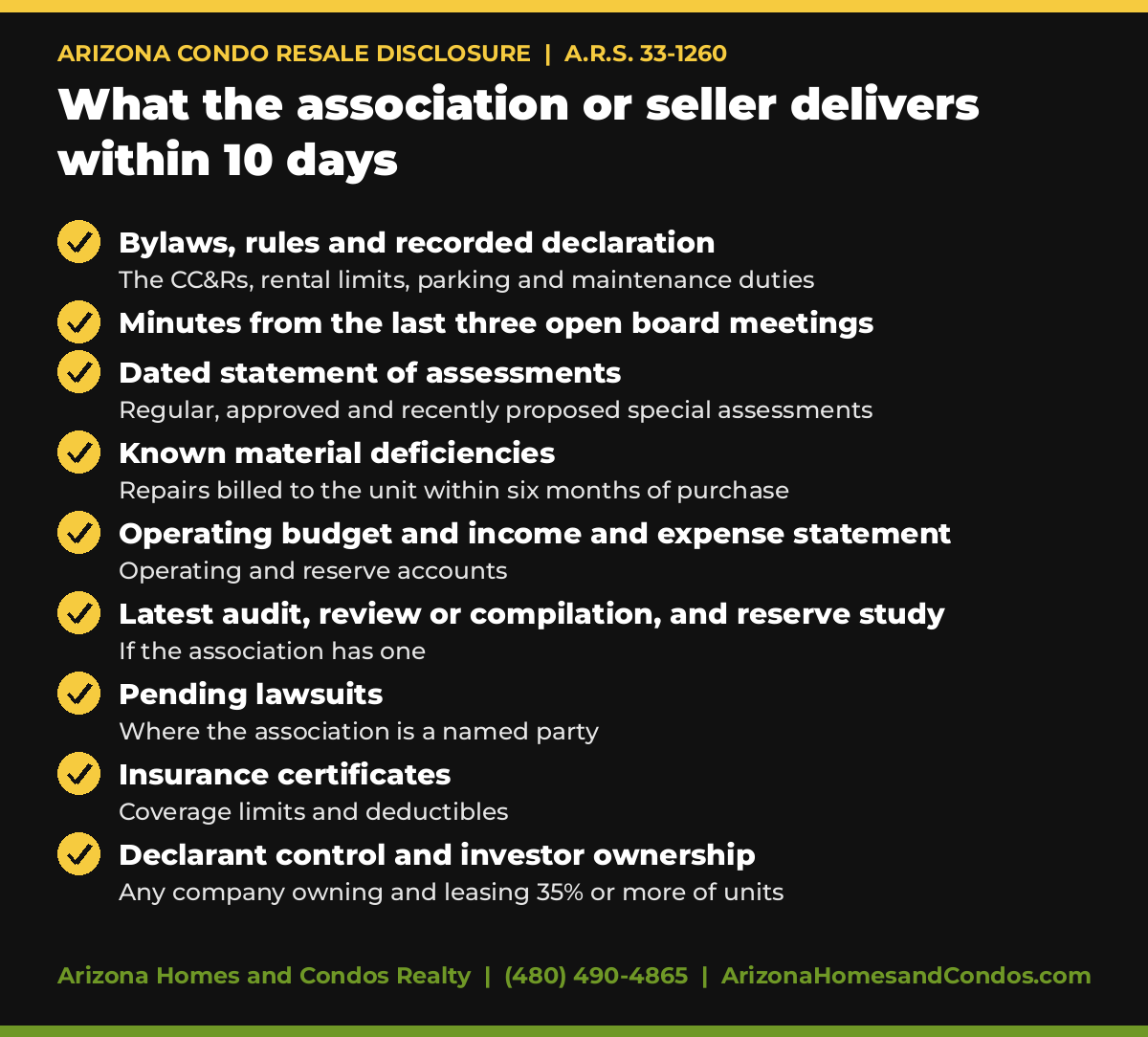
- Bylaws, rules and the recorded declaration (the CC&Rs). These set rental limits, pet rules, parking, and what the association maintains versus what you maintain.
- Minutes from the last three open board meetings. Minutes are often where roof, plumbing or insurance problems show up first, before any vote on new charges.
- A dated statement of assessments. It shows the regular assessment for the unit, any approved special assessments still being paid, and any proposed ones from the previous four months.
- Known material deficiencies. Repairs to common or limited common elements that you would be billed for within six months of purchase.
- The current operating budget and the latest income and expense statement for both operating and reserve accounts.
- The most recent audit, review or compilation report, and the most recent reserve study, if the association has one. A summary can be provided for long reports, and you can ask to see the full report.
- Pending lawsuits in which the association is a named party, other than routine assessment collections.
- Insurance certificates with coverage limits and deductibles, plus a statement on whether any part of the unit is covered by the association policy.
- Declarant control and investor ownership. Whether the developer still controls the association, and whether one company owns and leases thirty-five percent or more of the units.
Lenders review many of the same facts during project review, which is why condo financing and the document review run side by side. If a reserve study is missing, if minutes mention a large repair with no funding plan, or if a single owner holds a big share of units, we raise it before you are past your deadlines.
Condo insurance: what the master policy leaves to you
Every condo association carries a master policy, but what it covers differs from building to building. Some policies cover the structure only up to the unit’s bare walls; others include fixtures, cabinets and flooring that were part of the original build. Whatever the master policy leaves out becomes your job to insure with your own unit-owner policy, often called an HO-6 policy.
The resale disclosure must include the association’s insurance certificates with coverage limits and deductibles, and a statement on whether any part of the unit is covered by the association. We read that section with three questions in mind:
- Where does the master policy stop? That line decides how much interior coverage you need on your own policy.
- How large is the master deductible? Many declarations let the association pass some or all of a deductible to the owner whose unit caused or suffered the loss. Your own policy can often include coverage for that, called loss assessment coverage.
- Is water damage treated differently? In stacked buildings a leak can cross several units. The declaration and rules explain who repairs what, and that affects the coverage you choose.
Ask your insurance agent for a quote early in your inspection period, using the master certificate from the disclosure. Your lender will need proof of your coverage before closing, and getting the quote early means a surprise premium never shows up in the last week. Your condo agent sends the certificate to your insurance agent as soon as it arrives.
Step by step: buying a condo with our team
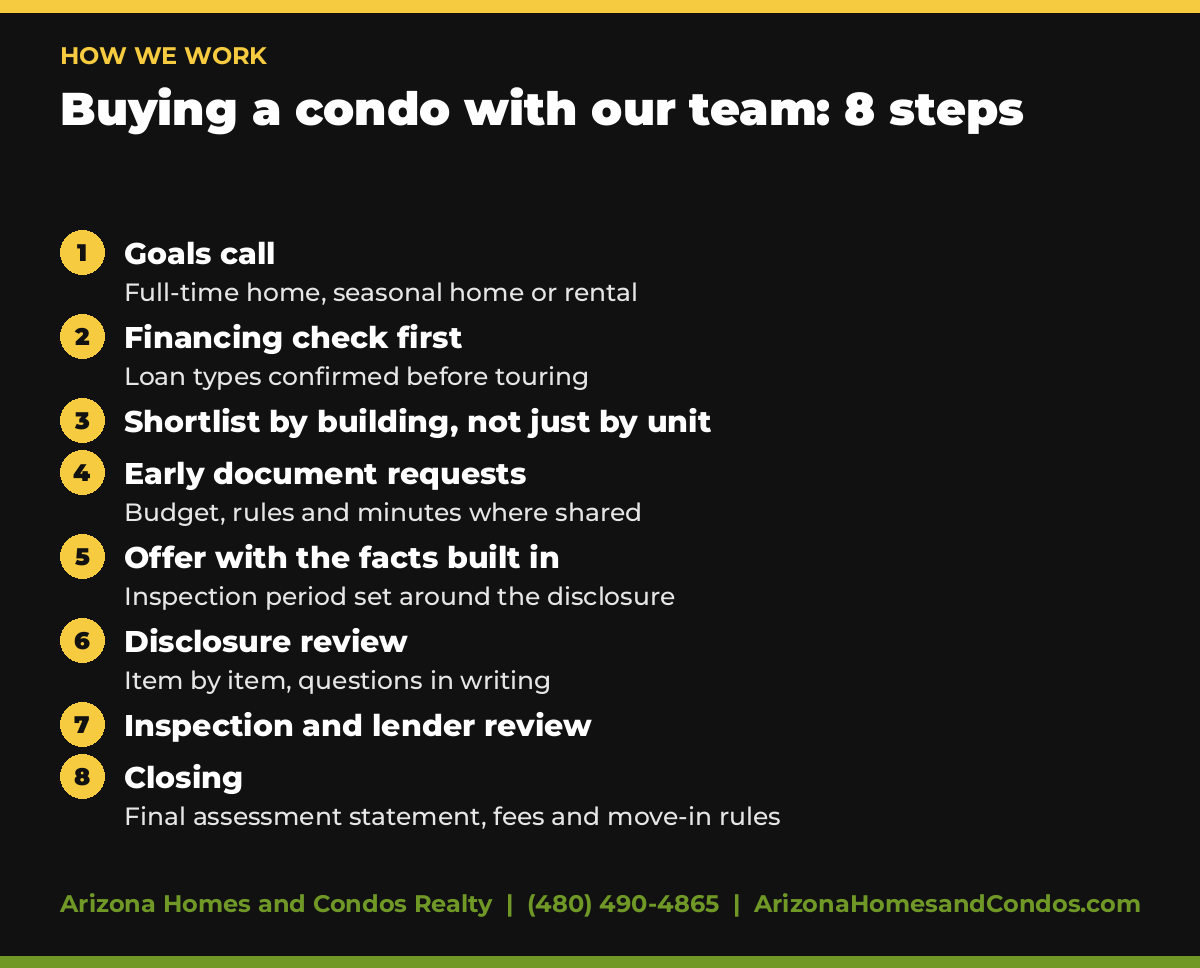
- Goals call. We start with how you plan to use the unit: full-time home, seasonal home, or rental. Use decides which rental rules, financing paths and building types fit.
- Financing check first. Before touring, we ask your lender which loan types you are approved for, so we can flag projects where condo financing may be harder, such as buildings that are not on an approved list or have open litigation.
- Shortlist by building, not just by unit. Two identical floor plans in different associations can carry very different budgets and rules, so we compare the associations as closely as the units.
- Early document requests. Where the seller or manager will share them before an offer, we read the budget, rules and recent minutes early. Anything we cannot see yet becomes a condition in the offer.
- Offer with the facts built in. Price, credits and dates reflect what we know about reserves and special assessments, and the inspection period is set so the statutory disclosure arrives in time to be read.
- Disclosure review. When the resale disclosure arrives, we go through it with you item by item and send your questions to the association or the seller in writing.
- Inspection and lender review. Your inspector covers the unit; we confirm with your lender that project review is moving and that no new item in the disclosure changes the loan.
- Closing. We confirm the final assessment statement, transfer fees and move-in rules (elevator reservations, parking passes, gate access) so your first week is calm.
Every step is handled by a dedicated full-time condo agent, never a call center. If you are selling a unit instead, our sellers agent page explains how we prepare association documents for buyers.
How working with our condo agent team works
- Clarify your budget, timeline, and whether you need owner-occupancy, investment use, or both.
- Shortlist communities and units that fit the building type and association profile you want.
- Order and review HOA docs, insurance and assessment history before or during your contingency.
- Coordinate with your lender on project eligibility early, not the week of closing.
- Negotiate price, credits and repairs with the association facts on the table.
Selling a condo instead? Our sellers agent page covers pricing, staging and disclosure for associations.
Condo buying FAQ
Do I need a condo agent if I already have a lender?
Yes. Your lender underwrites the loan; your agent works the contract, the association documents and the negotiation. Project approval still needs both sides talking early.
Can I use FHA on any Arizona condo?
No. The unit and the project must meet FHA rules. Start with HUD’s loan overview and confirm project status with your lender before you waive contingencies.
What if the HOA has a pending special assessment?
We quantify who pays, when it is due, and whether your lender will require it to be paid or escrowed at closing, then fold that into your offer strategy.
Condo or townhome: which is easier to finance?
It depends on how title and the association are structured, not the word on the listing. We confirm the legal form and the loan path before you compare monthly costs.
How fast will I hear back?
A dedicated full-time condo agent replies personally, usually the same day. The first conversation is about your goals, timeline and budget.
Do I need an agent to buy a condo?
You are not required to have one, but the listing agent represents the seller. A condo agent who represents only you reads the association documents, tracks the disclosure deadline and negotiates around what those documents show.
What questions should I ask the HOA before buying a condo?
Ask whether any extra assessments are approved or under discussion, when the reserve study was last updated, what the master insurance policy covers and its deductible, what the rental and occupancy rules are, and whether the association is in any lawsuits. Most of these answers are required in the resale disclosure under A.R.S. 33-1260.
What is a condo reserve study?
A reserve study lists the building parts the association must eventually replace, such as roofs, paving and pool equipment, estimates their remaining life, and compares that plan with the money in reserves. Arizona law requires the association to share its most recent reserve study, if one exists, in the resale disclosure.
What is the difference between a warrantable and a non-warrantable condo?
A warrantable condo meets the project rules that conventional loan programs use, such as limits on investor ownership, litigation and commercial space. A non-warrantable condo does not, so financing options narrow and terms can change. Your lender makes the final call; we flag the warning signs early.
Can you sell a condo without an agent?
Yes, an owner can sell without one. The seller still has to deliver the required association disclosures on time, so most owners use a full-time listing agent to handle the documents and pricing. See our sellers agent page for how that works.
Ready for an Arizona condo agent who works only for you?
Tell us the city or town, the property type and whether you are buying, selling or both. We assign a dedicated full-time local agent. Call (480) 490-4865 anytime, or send the form below.
Get started with a dedicated full-time agent
Two quick steps. A full-time local agent replies personally.
Do you know anyone looking to buy or sell real estate in Arizona? Share our website with them so they are fully informed.
Call Arizona Homes and Condos Realty at (480) 490-4865 or visit ArizonaHomesandCondos.com.