
Last Updated: October 2026
Arizona Pet Safety: 9 Desert Hazards That Can Kill Your Dog
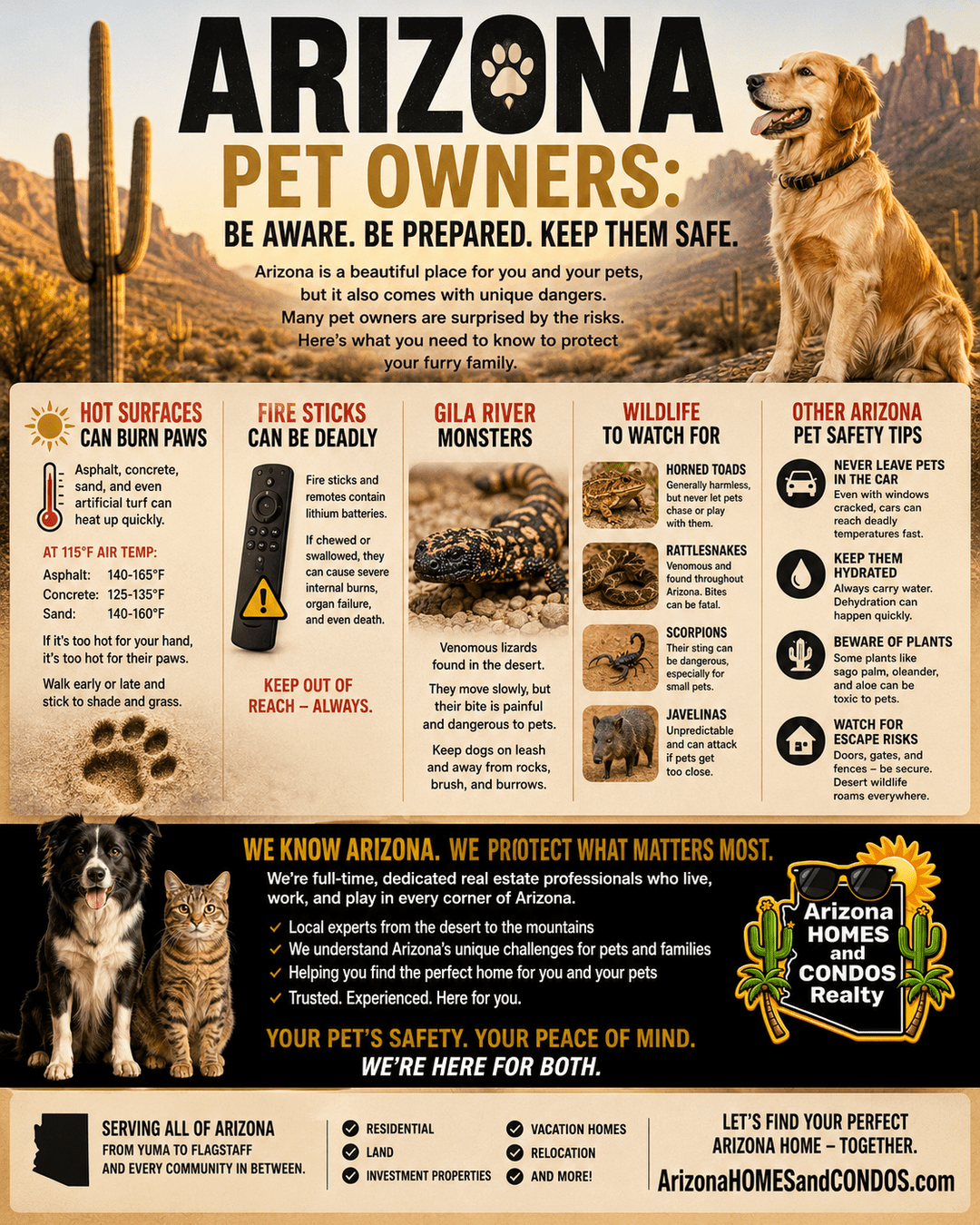
The first time a client called me in a panic, her new puppy was foaming at the mouth in a Fountain Hills backyard. She had moved from Ohio three weeks earlier and had never heard of the toad that nearly killed her dog. That call is why I treat Arizona pet safety as part of my job, not an afterthought. If you are relocating to the desert with a dog, the yard you fall in love with may hide threats your old hometown never had.
I have walked hundreds of out-of-state and out-of-country buyers through their first Arizona summer, and Arizona pet safety is the thread through every one of those conversations. The Arizona pet safety pattern is always the same: people plan for the heat on their own skin and forget the ground, the plants, and the wildlife are far more hostile to a four-legged family member. Arizona pet safety is not fear-mongering. It is the difference between a great relocation and a heartbreaking emergency-vet bill in your first month.
Why Arizona pet safety is different from anywhere you have lived
Back home, your vet probably never mentioned a venomous toad, a fungus in the dirt, or asphalt hot enough to fry an egg. Here, all three are routine, and each belongs in an honest Arizona pet safety conversation. Two-thirds of the country’s Valley fever cases happen in Arizona, and our deserts hold more rattlesnake species than any other state. Arizona pet safety means unlearning the assumptions you arrived with.
The relocation gap is real and dangerous. A vet in Ohio or Ontario may never have seen a Sonoran Desert toad poisoning or a Mojave rattlesnake bite. When a transplanted owner calls their old vet for advice, the clock is already against them. That is exactly why my Moving to Arizona guide now leads with pet hazards, and why I raise Arizona pet safety on the very first walkthrough.
Hazard exposure also tracks with geography, and that is where a real estate decision becomes a safety decision. A low-desert lot in Phoenix backing to a wash is a different risk profile than a pine-shaded home in Flagstaff. I will come back to that, because it is the part most newcomers never think to ask about, even though it shapes the whole Arizona pet safety picture.
1. The Sonoran Desert toad… Arizona’s quiet dog killer
Most newcomers brace for snakes. The bigger backyard killer is the Sonoran Desert toad, also called the Colorado River toad. Arizona Game and Fish reports it kills more dogs each year than rattlesnakes do. This is the single fact I most want every relocating owner to absorb for their Arizona pet safety plan.
It is the largest native toad in the United States, up to seven inches long, olive-brown, with two visible glands behind its eyes. Those glands secrete a potent neurotoxin, the core Arizona pet safety threat of monsoon season. A dog does not have to eat the toad. A single lick or a curious mouthing is enough for the poison to absorb through the gums.
It spends most of the year buried and emerges with the summer monsoon, roughly late June through September on Arizona Time. At night it hunts the insects that swarm around pool lights, irrigation, and landscape lighting, which is why so many poisonings happen in tidy suburban yards. The Pet Poison Helpline calls these toads a life-threatening emergency for pets.
If you are buying in toad country… Tucson, the East Valley, or anywhere in the low Sonoran Desert… I tell owners to kill the patio lights at night during monsoon and supervise every after-dark backyard break. Arizona pet safety in summer is mostly about the hours after sunset.
2. Arizona rattlesnake safety for relocating owners
Arizona has more rattlesnake species than any other state. The Western Diamondback is the one you will meet in nearly every neighborhood that borders native desert, from Cave Creek to the edges of Old Town Scottsdale. Arizona pet safety here means assuming the desert starts at your back wall. Real Arizona rattlesnake safety starts with a hard truth most newcomers get backwards.
Roughly two-thirds of rattlesnake encounters with dogs happen in or around the home, not on a hiking trail. Snakes follow rodents into yards and hide under bushes, against block walls, and near pool equipment. Dogs are about 20 times more likely than people to be bitten and 25 times more likely to die from it, which reframes Arizona rattlesnake safety for every new owner. If your lot borders a wash in Anthem or North Scottsdale, your backyard is habitat, and Arizona pet safety has to account for it.
The season is long. First bites are reported as early as February and as late as November, with snakes most active at dawn and dusk through the heat. Arizona rattlesnake safety is not a summer-only concern, and it does not stop at the patio door in a Paradise Valley hillside home.
Vaccine versus avoidance training
Owners always ask me which one to choose. The honest Arizona pet safety answer is that neither is a guarantee. The rattlesnake vaccine targets Western Diamondback venom and may buy time to reach a vet. It does not protect against the neurotoxic Mojave, and it is not a substitute for emergency care. Many Arizona vets lean toward avoidance training, which teaches a dog to smell, hear, and flee a snake on its own.
My take for Arizona rattlesnake safety: ask your vet about doing both, and rattlesnake-proof the yard if you back to desert. A bite can run into thousands of dollars at the ER vet, and small breeds fare worst. This is one place where I will not sugarcoat the cost of being unprepared.
3. Hot pavement dog paws… the injury I see every single summer
This is the most common and most preventable summer injury for relocating owners. People check the air temperature and forget the ground. Hot pavement dog paws are the injury I warn every newcomer about first. Hot pavement dog paws send dogs to Arizona vets all season, and it happens on days that do not even feel that hot to a person in shoes.
The numbers are brutal. When the air hits 86 degrees, asphalt can reach about 135 degrees. On a 95-degree Phoenix afternoon, asphalt can climb past 150 and concrete past 140. A surface at 125 degrees can burn a paw pad in about a minute. The American Kennel Club recommends a simple field test for hot pavement dog paws.
In low-desert markets like Buckeye, Goodyear, and Queen Creek, midday dog walks are simply off the table for much of the year. The fix for hot pavement dog paws is timing, not toughness, and it is a cornerstone of summer Arizona pet safety. I moved my own dog’s walks to first light from May through September, and you should plan to do the same.
4. Toxic plants for dogs hiding in your new landscaping
The Sonoran Desert holds thousands of plant species, and a surprising share are toxic plants for dogs. The trap for relocating buyers is that desert landscaping looks low-maintenance and harmless. A resale home’s xeriscape can be a buffet of hazards a new dog will happily investigate, so Arizona pet safety starts at the property line.
The worst offender people do not expect is the Firestick, also sold as Pencil Cactus or Sticks on Fire. Its milky sap is caustic. A peer-reviewed medical review notes the sap is among the most irritating plant substances known, capable of severe skin and eye injury. If a dog chews a stem, expect mouth pain, drooling, and vomiting.
The other common toxic plants for dogs in Arizona yards are oleander, which attacks the heart, and the sago palm, whose seeds can cause fatal liver damage with symptoms delayed up to 72 hours. Lantana and Mexican bird of paradise round out the list I check on most walkthroughs. Before you let a new dog roam, identify what is already planted as a basic Arizona pet safety step.
5. Venomous lizards, scorpions, and surprising critters
The Gila monster is the lizard people fear most, and the one your brief may have called a “Gila River monster.” It is a slow, beaded, venomous lizard that bites and chews to deliver venom, gripping hard and sometimes leaving teeth in the wound. Bites are rare but painful and prone to infection. The good news for Arizona pet safety: they are slow and reclusive, so keep curious dogs from cornering one.
The Arizona bark scorpion is the most venomous scorpion in the country. It hides in woodpiles, garages, and dark corners, and glows under UV light. For most dogs a sting causes local pain and brief neurological signs, but watch a small dog closely and call your vet. Shake out shoes and gear, and a blacklight sweep of a new yard at night is worth the ten minutes for peace of mind and Arizona pet safety.
Here is reassurance to balance the alarm: the “horny toad,” properly the horned lizard, is largely harmless and actually beneficial. The giant desert centipede delivers a painful pinch but is not deadly to dogs. Part of Arizona pet safety is knowing which desert creatures to respect and which to leave in peace.
6. Valley fever… the desert illness your old vet may miss
Valley fever, or coccidioidomycosis, is a fungal infection from spores in the desert soil, and it is one of the most under-appreciated Arizona pet safety issues for newcomers. About two-thirds of the nation’s cases occur in Arizona, and dogs make up the majority of animal cases, which makes it a core Arizona pet safety issue here.
The University of Arizona estimates that 6 to 10 percent of dogs in Maricopa County, Pima County, and Pinal County get sick with Valley fever every year. Dogs that dig or hike in disturbed soil are most exposed, especially after monsoon winds. Statewide, Valley fever costs Arizona dog owners an estimated 60 million dollars a year.
Symptoms are a dry cough, limping or bone pain, fever, low appetite, and weight loss, often about three weeks after exposure. Treatment is antifungal medication that frequently runs 6 to 12 months or longer. The danger for transplants is misdiagnosis: an out-of-state vet may mistake it for cancer or pneumonia. Tell any vet you have lived in or visited Arizona; it is the simplest Arizona pet safety step a transplant can take.
7. Coyotes, javelina, owls, and yard threats by region
Urban wildlife is a genuine Arizona pet safety concern, especially for small dogs. Coyotes hunt in neighborhoods at dawn and dusk and will take a small dog from an unfenced yard. Great horned owls can lift very small pets. A six-foot solid fence and never leaving a small dog outside alone at night are the simplest Arizona pet safety protections.
Javelina are the surprise. These pig-like animals travel in herds, see poorly, and may charge a dog they mistake for a coyote. In Tucson, wildlife officials report dog owners are attacked roughly every few months. If you meet a herd while walking, turn around calmly, pick up a small dog, and make noise. Do not let your dog give chase.
Foxtails and grass awns deserve a mention too. Their barbed seed heads burrow into ears, eyes, paws, and noses, and often need surgical removal. Add cholla cactus segments and Africanized bees, and you can see why Arizona pet safety rewards owners who know their specific terrain rather than relying on generic advice.
8. Your hazard map changes by elevation and city
Here is the part no listing page tells you, and the reason Arizona pet safety is really a real estate question. The threats above are concentrated in the low Sonoran Desert. Climb a few thousand feet and the picture changes dramatically.
Even Sedona at mid-elevation splits the difference. My Arizona climate comparison guide breaks the regions down by elevation, and it is worth reading before you fixate on one city. For a pet-focused buyer, the right elevation can remove half this list before you ever sign a contract.
9. The relocation mistakes that put pets at risk
The costliest errors I see are avoidable. Buyers tour in winter, never picture an August walk, and end up with a black-asphalt driveway and no shade. Or they pick a wash-adjacent lot for the view without weighing the rattlesnake reality. Arizona pet safety belongs in the home search, not the move-in panic.
Budget plays in too. A surprise Valley fever course or a rattlesnake ER visit can blow a tight post-move budget. Plan for it the same way you would a roof or an HVAC reserve, because Arizona pet safety carries a real line item. My relocation mistakes guide and cost of living breakdown both fold pet-related costs into the real number. If you are buying into an HOA, my HOA survival guide covers pet and landscaping rules that can surprise you.
Match me with a pet-savvy local agent
Arizona pet safety is a location decision as much as a vet decision. As your Dedicated Full-Time Local Agents, we match relocating dog owners to the home, lot, and region that actually fit your pet… not just your price band. No sales pressure, personal response, typically within 2 to 4 hours, 7 days a week.
Match Me With a Full-Time Agent Find My Buyer’s AgentI built this brokerage around dedicated full-time agents for one reason: a part-timer juggling another career does not have the local read that protects your family, pets included. Arizona pet safety is exactly the kind of block-by-block knowledge that separates a true specialist from someone working real estate on the side. When you are ready, I will put that knowledge to work on your search.
Arizona Pet Safety… Frequently Asked Questions
What is the most dangerous animal for dogs in Arizona?
For Arizona pet safety, the deadliest threat is not what most newcomers guess. Arizona Game and Fish reports the Sonoran Desert toad kills more dogs each year than rattlesnakes do. The toad secretes a neurotoxin a curious dog absorbs just by mouthing it. Rattlesnakes are a close second. Both are most active in the warm months, and both turn up in ordinary backyards across the low desert.
How do I make my new Arizona home safe for pets?
Good Arizona pet safety starts with the yard. I tell relocating buyers to remove toxic plants for dogs, install rattlesnake fencing where a lot borders desert, turn off bug-attracting patio lights at night, and never walk a dog on hot pavement at midday. Beyond the fence line, the bigger question is location. A dedicated full-time agent who knows a submarket can flag which yards and neighborhoods carry the highest risk before you write an offer.
What does a Sonoran Desert toad do to a dog?
When a dog licks or bites a Sonoran Desert toad, the toad releases a milky neurotoxin from glands behind its eyes. Within minutes a dog may drool heavily, foam, paw at the mouth, show bright red gums, stagger, and in serious cases seize or collapse. It is a true emergency. Rinse the mouth from back to front with a hose for several minutes, point the water out so the dog does not swallow it, then get to an emergency vet fast.
When are Sonoran Desert toads most active in Arizona?
The Sonoran Desert toad spends most of the year underground and emerges with the summer monsoon, roughly late June through September on Arizona Time. They come out at night after rain, hunting insects near pools, irrigation, and patio lights. That is exactly when I tell dog owners to supervise every backyard trip after dark and keep outdoor lighting low.
Does the rattlesnake vaccine work, or is avoidance training better?
Both have a place in Arizona rattlesnake safety, but neither is a force field. The vaccine targets Western Diamondback venom and may buy you time to reach a vet. It does not protect against the neurotoxic Mojave, and it does not replace emergency care. Many Arizona vets favor avoidance training, which teaches a dog to smell, hear, and flee a snake on its own. I usually suggest owners ask their vet about pairing both.
Where do most Arizona rattlesnake dog bites happen?
Not on the trail. Trainers estimate roughly two-thirds of rattlesnake encounters with dogs happen in or around the home, because snakes follow rodents into yards and hide under bushes, block walls, and pool equipment. That is the heart of Arizona rattlesnake safety: if your lot borders a wash or open desert in places like Cave Creek, Anthem, or North Scottsdale, your own backyard is snake habitat.
How hot is too hot for hot pavement and dog paws?
Use the seven-second rule. Press the back of your hand to the surface for seven seconds; if you cannot hold it, it is too hot for hot pavement dog paws. When the air hits 86 degrees, asphalt can reach about 135 degrees, and on a 95-degree afternoon it can climb past 150. A surface at 125 degrees can burn a paw pad in about a minute. In the low desert that means midday walks are out for much of the year.
How do I protect dog paws from hot pavement in Arizona?
Walk at dawn or after dark when surfaces cool, stick to grass and shade, and test with the seven-second rule first. Booties and paw wax add a barrier, and conditioning paws on cool mornings toughens them. The simplest fix for hot pavement dog paws is timing: I move my own dog walks to first light from May through September.
What are the most common toxic plants for dogs in Arizona yards?
The Sonoran Desert holds thousands of plant species, and a surprising number are toxic plants for dogs. The ones I see most in resale-home landscaping are oleander, sago palm, lantana, Mexican bird of paradise, and the Firestick or Pencil Cactus. Oleander affects the heart, sago palm can cause liver failure, and the Firestick sap causes chemical burns. Identify what is already planted before you let a new dog roam the yard.
Is the Firestick (Pencil Cactus) plant poisonous to dogs?
Yes. The Firestick, also sold as Pencil Cactus or Sticks on Fire, is one of the most common toxic plants for dogs in Arizona xeriscaping. Its milky sap is caustic. If a dog chews a stem it can cause painful mouth and stomach irritation, drooling, and vomiting, and sap in the eyes can cause temporary blindness. It is striking in a desert yard and genuinely dangerous, so I flag it on every walkthrough.
Can a real estate agent really help me find a pet-safe Arizona home?
Yes, and it is one of the most overlooked parts of Arizona pet safety. Hazard risk changes block by block: low-desert yards near washes mean snakes and toads, while higher-elevation towns see far fewer. As your Dedicated Full-Time Local Agents, we match relocating pet owners to the home, lot, and region that fit their dog, not just their budget. That is the kind of local read a part-time agent simply does not have.
Arizona is one of the best places in the country to own a dog, once you know the terrain, which is what Arizona pet safety really comes down to. Get the yard, the timing, and the location right, and the hazards on this page become manageable details instead of emergencies, and that calm is the real payoff of good Arizona pet safety. That is the promise behind Dedicated Full-Time Local Agents, and it is the standard I hold for every relocating owner I help.