
Is It a Buyer’s Market in Arizona Right Now? (Homes and Condos)
Short answer: it is becoming a buyer’s market in Arizona, but not everywhere. Our Valley market index tracking shows 10 of 18 Valley cities are now buyer’s markets, the most since December 2022, and Mesa and Glendale crossed over the week of October 29, 2026. Phoenix is balanced and Scottsdale is still a seller’s market. For homes and condos, the answer changes city by city, so here is our data.
Talk to a full-time dedicated agent or call (480) 490-4865
Is it a buyer’s market in Arizona right now? What our data shows
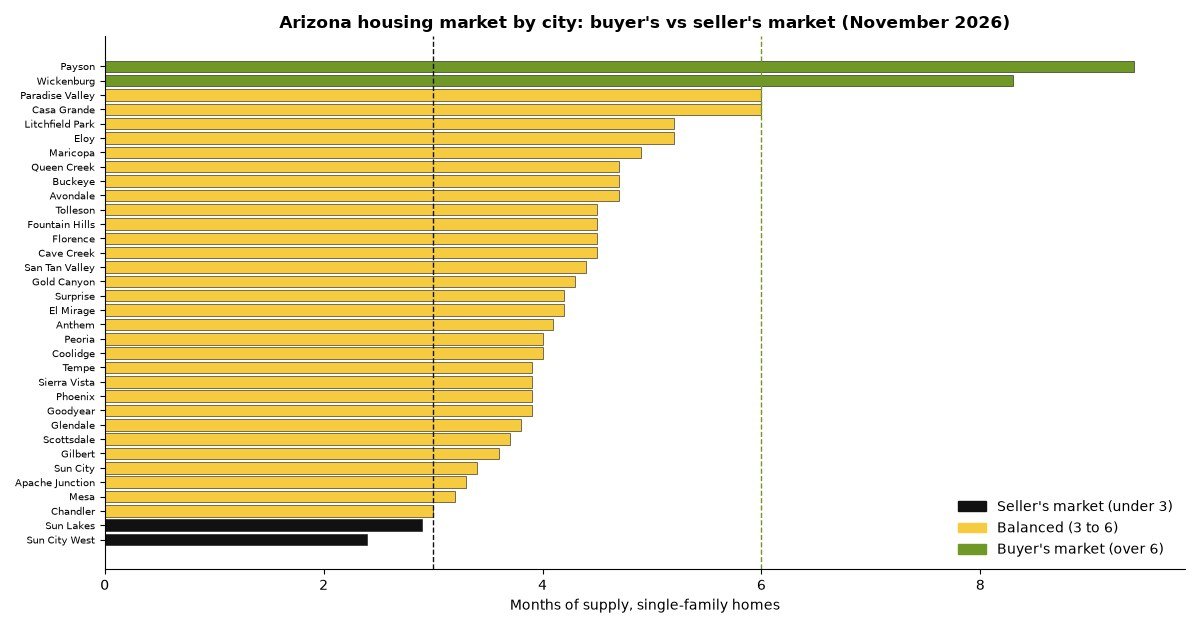
We sort each market by months of supply (a 3-month average): under 3 months is a seller’s market, 3 to 6 months is balanced, and over 6 months is a buyer’s market. Here is the latest report month for the largest Valley cities, for single-family homes and for condos and townhomes. See every city on our Arizona housing market by city page.
| City | Homes: months of supply | Homes | Condos: months of supply | Condos | Home median | Condo median |
|---|---|---|---|---|---|---|
| Phoenix | 3.9 | Balanced | 6.4 | Buyer’s | $485,000 | $329,000 |
| Mesa | 3.2 | Balanced | 4.6 | Balanced | $492,500 | $275,000 |
| Glendale | 3.8 | Balanced | 6.5 | Buyer’s | $420,000 | $222,500 |
| Scottsdale | 3.7 | Balanced | 5.7 | Balanced | $1,200,000 | $485,000 |
| Chandler | 3.0 | Balanced | 4.2 | Balanced | $549,500 | $312,500 |
| Gilbert | 3.6 | Balanced | 5.8 | Balanced | $584,343 | $350,000 |
| Tempe | 3.9 | Balanced | 7.1 | Buyer’s | $525,000 | $300,000 |
| Peoria | 4.0 | Balanced | 5.3 | Balanced | $515,000 | $297,500 |
Our data, October 2026 report (September 2026 closings). Months of supply is a 3-month average.
Homes vs condos: where buyers have the most leverage
Single-family homes in these eight cities sit between 3.0 months (Chandler) and 4.0 months (Peoria) of supply, which is balanced. Condos and townhomes are a different story. Tempe condos are at 7.1 months, Glendale at 6.5 and Phoenix at 6.4, all in buyer’s-market territory. If you are shopping for a condo in the Valley, you likely have more room to ask for price cuts, repairs or seller-paid closing costs.
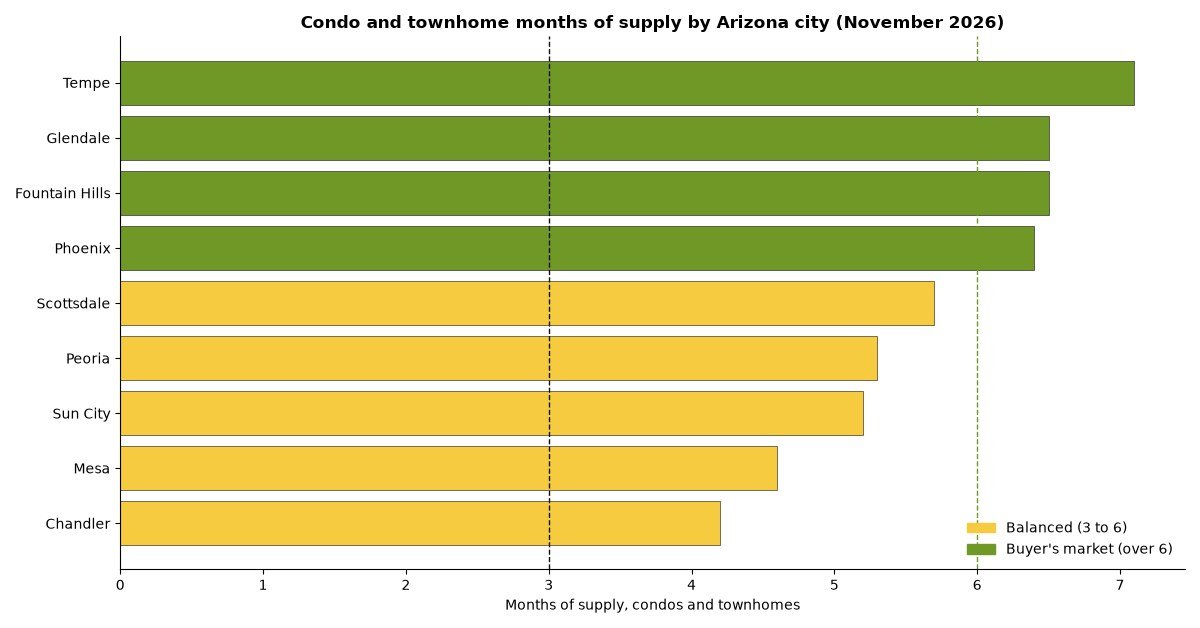
Why the gap? Condo and townhome buyers in Arizona are often snowbirds, investors and first-time buyers, and that demand moves faster with the seasons and with monthly payments. When condo listings pile up, sellers have to compete. In Chandler, condo supply is 4.2 months and in Mesa it is 4.6 months, so those condo markets are balanced. In Scottsdale it is 5.7 months, in Gilbert 5.8 and in Peoria 5.3, close to the 6-month line.
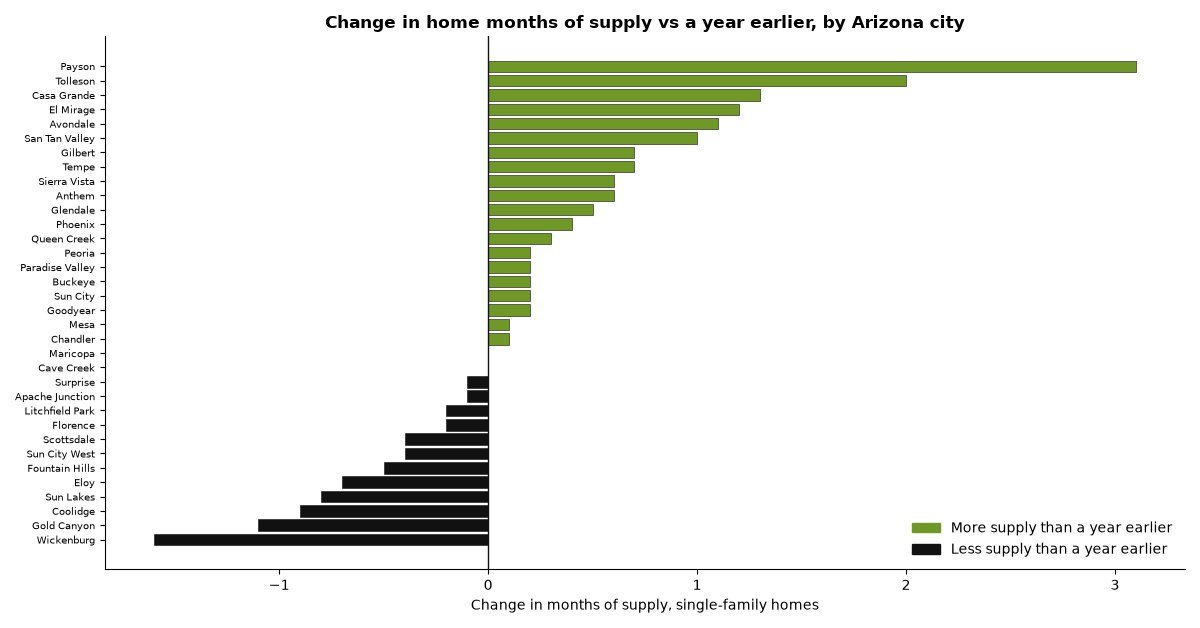
Supply is up from a year earlier in most big Valley cities
Months of supply for homes rose from a year earlier in most of the large Valley cities. Phoenix homes went from 3.5 to 3.9 months, Glendale from 3.3 to 3.8, Gilbert from 2.9 to 3.6, Tempe from 3.2 to 3.9 and Peoria from 3.8 to 4.0. Mesa (3.1 to 3.2) and Chandler (2.9 to 3.0) barely moved. Scottsdale went the other way, from 4.1 to 3.7 months, which helps explain why it still leans toward sellers.
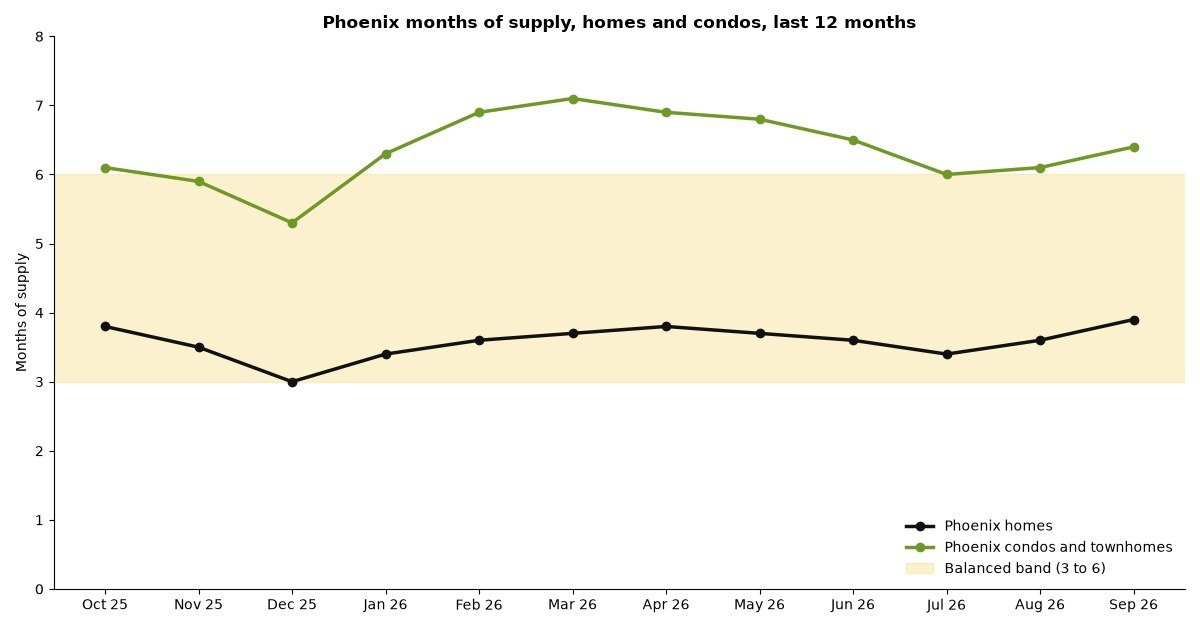
In Phoenix, condo and townhome supply has stayed near or above 6 months for most of the past year, while home supply has stayed in the balanced band. Condo buyers in Phoenix have had leverage for months, not just weeks.
Mesa and Glendale just crossed into buyer’s-market territory
In our Valley market index, Mesa and Glendale moved into buyer’s-market territory the week of October 29, 2026. By months of supply, though, homes in both cities are still balanced. The index reacts faster to weekly changes in listings and contracts, while months of supply is a 3-month average, so the two can disagree for a while when a market is turning. Mesa homes have 3.2 months of supply with a $492,500 median; Mesa condos have 4.6 months with a $275,000 median. Glendale homes have 3.8 months with a $420,000 median, and Glendale condos 6.5 months with a $222,500 median.
So what does that mean in practice? In Mesa and Glendale, home buyers are seeing the market tilt their way, but by supply it is still a balanced market, not a clearance sale. Glendale condo buyers are the clear exception: at 6.5 months of supply, that segment is in buyer’s-market territory on both measures.
Phoenix is balanced, Scottsdale still favors sellers
Our index has Phoenix balanced. Phoenix homes show 3.9 months of supply and a $485,000 median sale price. Scottsdale remains a seller’s market in our index, with homes at 3.7 months of supply and a $1,200,000 median. In the East Valley, Chandler (3.0 months) and Gilbert (3.6 months) homes are balanced, and in the West Valley Peoria homes are at 4.0 months.
How months of supply is calculated
Months of supply answers one question: if no new homes were listed, how many months would it take to sell every home that is for sale now? It is the number of active listings divided by the number of homes that sell in a month. We use a 3-month average of that figure, so one unusually slow or busy month does not flip a city’s label. Under 3 months means homes sell faster than new ones come on, so sellers have the edge. From 3 to 6 months is balanced. Over 6 months means listings are piling up faster than buyers can absorb them, which is a buyer’s market.
Months of supply is only one measure. It does not tell you how a single street, building or price range is doing. A city can be balanced overall while its condos, its luxury homes or one neighborhood lean toward buyers. That is why we show homes and condos separately for every city.
Homes vs condos by city: the side-by-side
In every city in our table, condos and townhomes have more months of supply than single-family homes. The gap is widest in Tempe (7.1 months for condos vs 3.9 for homes), Glendale (6.5 vs 3.8) and Phoenix (6.4 vs 3.9). It is narrowest in Chandler (4.2 vs 3.0) and Mesa (4.6 vs 3.2). In Scottsdale, condos are at 5.7 months against 3.7 for homes, with a $485,000 condo median against a $1,200,000 home median.
For a buyer deciding between a home and a condo in the same city, that gap matters. In Tempe, Glendale and Phoenix, a condo buyer usually has more listings to compare and more room to ask for concessions than a home buyer in the same city. In Chandler and Mesa, condo and home buyers face similar balanced conditions.
Negotiation and concessions: balanced vs buyer’s markets
In a balanced market (3 to 6 months), which describes homes in all eight cities above, expect fair negotiation. Many sellers will consider reasonable offers below list price, especially on homes that have been on the market a while, and repair requests after inspection are normal. Seller help with closing costs is common but not guaranteed, and well-priced, move-in-ready homes can still draw more than one offer.
In a buyer’s market (over 6 months), which describes condos and townhomes in Tempe, Glendale and Phoenix, buyers can push harder. That can mean a larger price reduction, seller-paid closing costs or a rate buydown, a home warranty, longer inspection periods, or a flexible closing date. For condos, also ask for the HOA documents early and compare the monthly dues and any special assessments between buildings, because with more choices you can walk away from a building that does not fit your budget.
What it means for buyers vs sellers of homes and condos
Home buyers: the market is balanced, so you can negotiate, but the best-priced homes still move. Have your financing ready and focus your leverage on homes that have sat. Condo buyers: in Tempe, Glendale and Phoenix you have the most leverage you will find in the Valley right now. Home sellers: price for a balanced market and expect requests for repairs or closing-cost help. Condo sellers: in buyer’s-market cities you are competing with many similar units, so price, condition and presentation decide who sells first.
What a buyer’s market in Arizona means for you
- Buyers: more homes and condos to choose from, more time to decide, and more room to negotiate on price, repairs and closing costs.
- Sellers: price right from day one, prepare the home well, and expect buyers to ask for concessions.
- Everyone: markets shift week to week. A city can cross from balanced to buyer’s in a single week, as Mesa and Glendale just did.
How to negotiate in a buyer’s market in Arizona
A buyer’s market does not mean every seller will take a low offer. It means you have options, and options are leverage. Here is how we help buyers use it:
- Check the months of supply for your exact city and home type. A Tempe condo at 7.1 months is a very different negotiation than a Chandler home at 3.0 months.
- Look at how long the home has been listed. Homes and condos that have sat longer than the local norm often have the most flexible sellers.
- Ask for more than price. Repairs, a home warranty, or seller-paid closing costs can be worth as much as a price cut.
- Keep your inspection and appraisal protections. In a balanced or buyer’s market there is less pressure to waive them.
- Get pre-approved before you shop. A strong, clean offer still wins the best homes, even when buyers have the upper hand.
What sellers should do now
If you are selling a home or condo in a city that has crossed into buyer’s-market territory, the first two weeks on the market matter most. Price to the current months of supply, not last spring’s numbers. Make repairs before listing, and plan for buyers to ask for help with closing costs. Sellers in balanced cities like Chandler, Gilbert and Phoenix still have room, but the trend is toward more supply. Before you hire anyone to help you buy or sell, you can verify their license with the Arizona Department of Real Estate.
Frequently asked questions
Is it a buyer’s market in Arizona right now?
It depends on the city and the home type. Our latest Valley market index tracking shows 10 of 18 Valley cities in buyer’s-market territory, the most since December 2022. By months of supply, single-family homes in the major Valley cities are balanced (3.0 to 4.0 months), while condos and townhomes in Phoenix, Glendale and Tempe are above 6 months, which is buyer’s-market territory.
Which Arizona cities just became buyer’s markets?
Mesa and Glendale crossed into buyer’s-market territory in our Valley market index the week of October 29, 2026.
What months of supply means a buyer’s market?
We use a simple rule: under 3 months of supply is a seller’s market, 3 to 6 months is balanced, and over 6 months is a buyer’s market. Our months-of-supply figure is a 3-month average.
Are condos a better deal than homes in Arizona right now?
Condos and townhomes have more supply than single-family homes in every city we track here. Tempe condos are at 7.1 months, Glendale at 6.5 and Phoenix at 6.4, so condo buyers there have more room to negotiate.
Is Scottsdale a buyer’s market?
No. Our Valley market index still shows Scottsdale as a seller’s market. Scottsdale single-family homes have 3.7 months of supply (balanced) and a $1,200,000 median sale price.
Talk to a full-time dedicated agent
Get a free, no-pressure read on whether your city and home type favor buyers or sellers right now. Or call (480) 490-4865.