CLUE Report: How a $0 Insurance Claim Can Follow an Arizona Home
Last Updated: November 2026
A CLUE report is the insurance claims history that follows a property, and most Arizona homeowners have never seen theirs. It can affect what you pay for insurance, whether your insurer renews you, and whether your buyer can get a policy in time to close.
Below we walk through how one storm, one phone call and one claim that paid nothing can show up again when you sell. Then we cover what Arizona law actually says, the right way to ask your insurer a question, and separate steps for sellers and buyers. This is general education, not legal or insurance advice, so confirm your own situation with a licensed insurance agent.
Here’s how it plays out: one storm, one call, one $0 claim
Example only: this is a typical Arizona scenario we built to explain how the pieces connect. It is not a real client, and every dollar figure in it is an illustration, not a quote.
A monsoon or hail storm rolls through. The next morning a roofer knocks on the door, offers a free roof check, climbs up and points to a few creased shingles. He says the insurance company owes a brand new roof and offers to get the claim started right there in the driveway.
The homeowner calls the claims line and reports roof damage. That is a claim, not a question. An adjuster comes out and writes up the creased shingles at, for example, $900. With an example deductible of $2,500, the insurer pays nothing.
The homeowner figures no harm done. But a claim was opened and investigated, so it can be reported to the CLUE database as a wind or hail claim with $0 paid. At the next renewal, the insurer may decide not to renew. In Arizona it has to send written notice at least 30 days before the policy ends and state the specific reasons.
Months later, the home goes on the market
The seller accepts an offer. Close to the closing date, the buyer finally shops for homeowners insurance. The buyer’s insurer pulls the CLUE report on the address, sees a recent roof claim and no record of a repair, and asks for a roof inspection or proof of repair before it will write a policy.
Without proof of homeowners insurance, the buyer’s loan cannot fund. Now the seller is negotiating a roof under a deadline, or watching the deal fall apart. None of this required a leak, and none of it required the insurer to pay a dime.
The good news: almost every step in this example can be prevented with a little knowledge and a full-time agent who asks the right questions early.
What a CLUE report is and what it shows
CLUE stands for Comprehensive Loss Underwriting Exchange. It is a claims database run by LexisNexis, and insurers use it when you apply for a policy or ask for a quote. The Consumer Financial Protection Bureau lists it as a specialty consumer reporting company that keeps up to seven years of home and personal property claims.
Is a CLUE report tied to the address or the owner?
Both, and that surprises people. Insurance regulators describe a home claim record as including the policyholder’s name, date of birth and policy number plus the property address and a description of the property. The Washington insurance commissioner notes that insurers use your claims history or the history of claims at a specific property. So a buyer can inherit questions about claims the last owner made.
What gets reported, including $0 claims
- Claims the insurer pays.
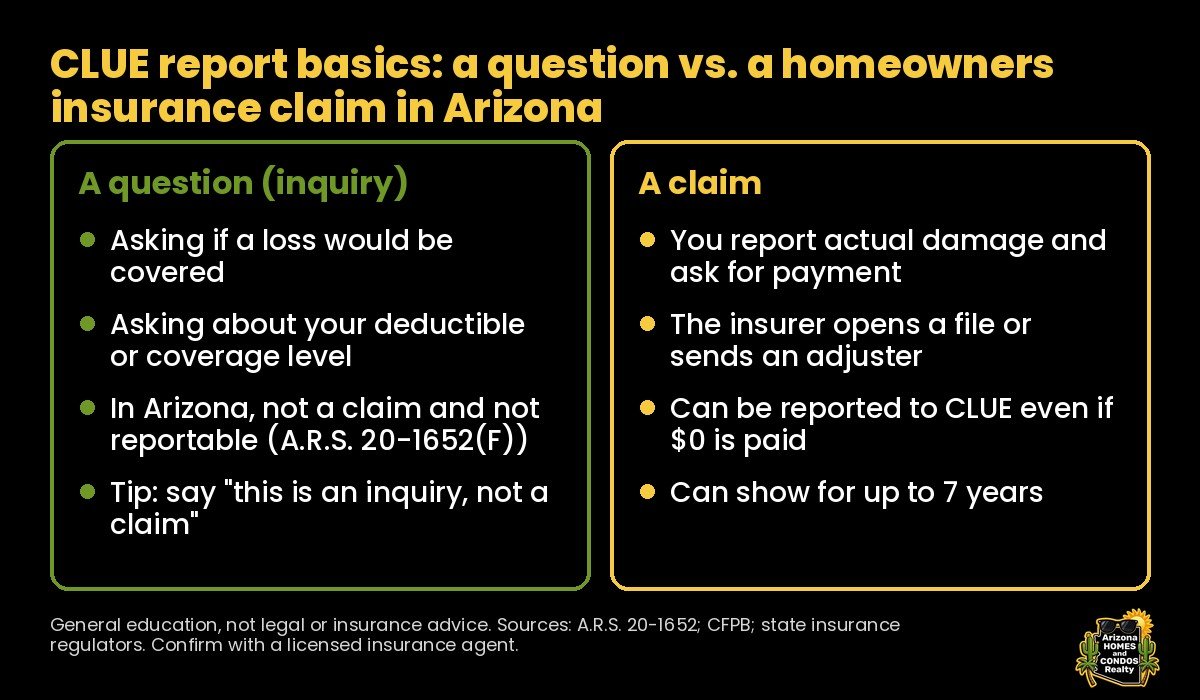
- Claims the insurer opens a file on, even if it pays nothing because the damage was under the deductible.
- Claims the insurer formally denies.
LexisNexis tells insurers not to report a simple question about coverage or your deductible. The Connecticut Insurance Department explains that if you filed an actual claim and nothing was paid, it may still appear on a CLUE report.
What Arizona law says about claims, questions and nonrenewal
Arizona gives homeowners real protections, and they are worth knowing before you pick up the phone. The key statute is A.R.S. 20-1652.
A question is not a claim in Arizona
Under A.R.S. 20-1652(F), an insurer cannot treat your question about whether a policy covers a loss, or about your type or level of coverage, as a claim. It cannot use that question to decline, cancel or nonrenew your coverage, and it cannot report a mere inquiry to a consumer reporting agency. A question becomes claim activity only when you actually file a claim that the insurer investigates.
Cancellation and nonrenewal are different
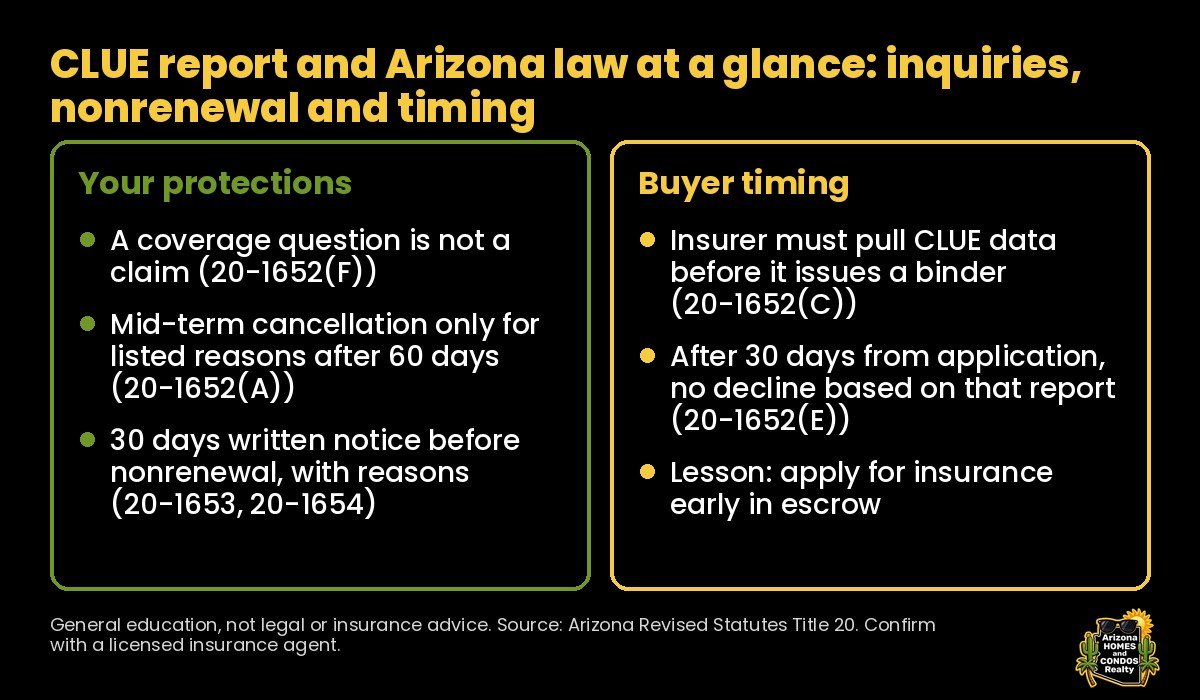
Once a home policy has been in force for 60 days, or at renewal, an Arizona insurer can cancel mid-term only for listed reasons such as nonpayment, fraud or a substantial change in the risk. Nonrenewal at the end of the term is allowed, but the insurer must send written notice at least 30 days before the policy period ends (A.R.S. 20-1654) and state the specific facts behind it (A.R.S. 20-1653). If the nonrenewal is based on the condition of the home, you get 30 days to fix the issue.
The timing rule that protects buyers
Arizona also requires an insurer that uses CLUE or similar data to pull it as soon as practicable after you apply and before it issues a binder. After 30 days from the application, it cannot decline you or end a binder based on that report, although it can still act on a physical inspection of the home. Translation for buyers: apply for insurance early.
Storm chasers, Arizona roofing rules and your CLUE report
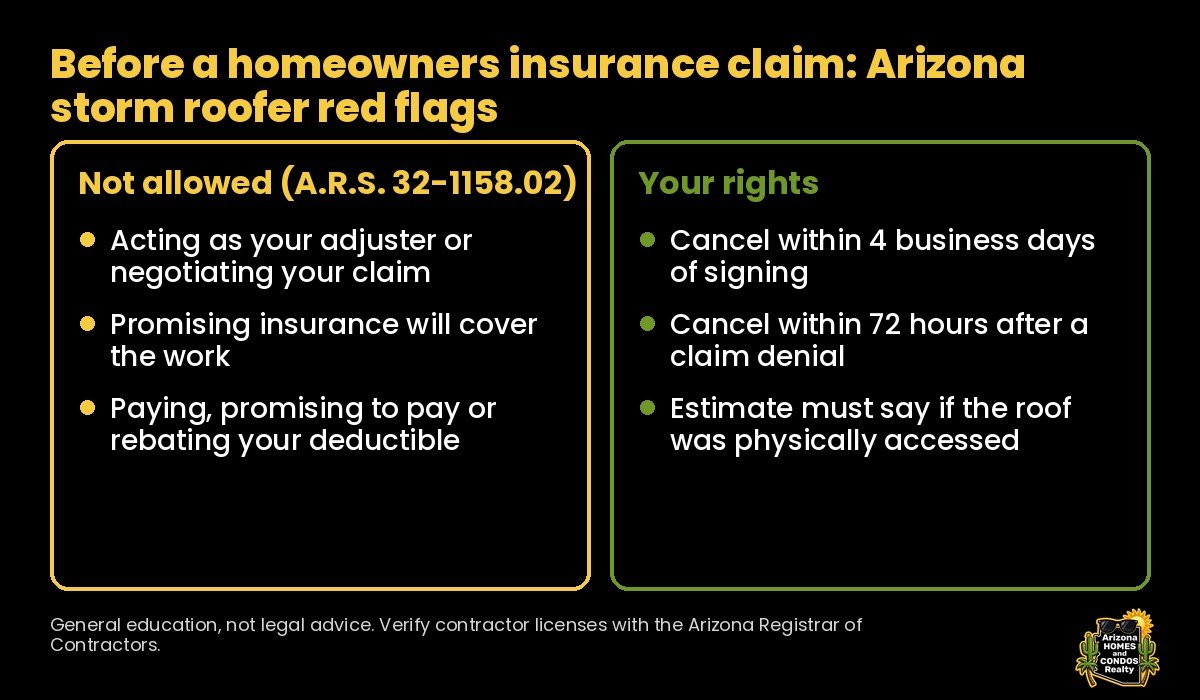
Arizona tightened the rules for post-storm roof work in A.R.S. 32-1158.02. A contractor doing storm repair cannot act as your adjuster, cannot negotiate your claim for you and cannot promise that insurance will cover the work.
- The contractor cannot advertise, pay, promise to pay or rebate your deductible.
- The estimate must describe the exact damage, say whether the roof was physically accessed and state that no one has promised insurance coverage.
- You can cancel within four business days of signing, and within 72 hours after the insurer tells you the claim is denied.
Before you let anyone start a claim for you, check the contractor’s license with the Arizona Registrar of Contractors, get your own estimate, and decide on your own whether the damage is worth a claim.
3 homeowners insurance claim rules, fact-checked
You may have seen a viral post with three rules about this database. The spirit is right, but some of the details were off for Arizona. Here is the corrected version.
1. Ask the right way, and know when a call becomes a claim
Arizona protects questions about coverage, so you do not need to fear asking. When you call, say plainly that you are making an inquiry and not filing a claim. The Arizona Department of Insurance and Financial Institutions gives the same advice. Reporting actual damage and asking the insurer to investigate is a claim, and it can be recorded even if nothing is paid. Many homeowners talk it through with their own licensed insurance agent before a call turns into a homeowners insurance claim.
2. Do the math before you file a homeowners insurance claim
There is no magic dollar number. The Arizona Department of Insurance says if repairs may cost less than your deductible, consider paying them yourself, because a homeowners insurance claim can raise your rates or lead to nonrenewal even when the insurer paid nothing. Rate studies give a sense of scale: Insurance.com reported in 2026 that one water damage claim raised premiums by an average of 25%, and two claims within three years raised them 25% to 55% depending on claim type. These are national averages, so ask your agent how your insurer prices claims.
A simple test: compare what the claim would pay after your deductible against several years of a higher premium, then decide.
3. Get the claims history in writing during your purchase
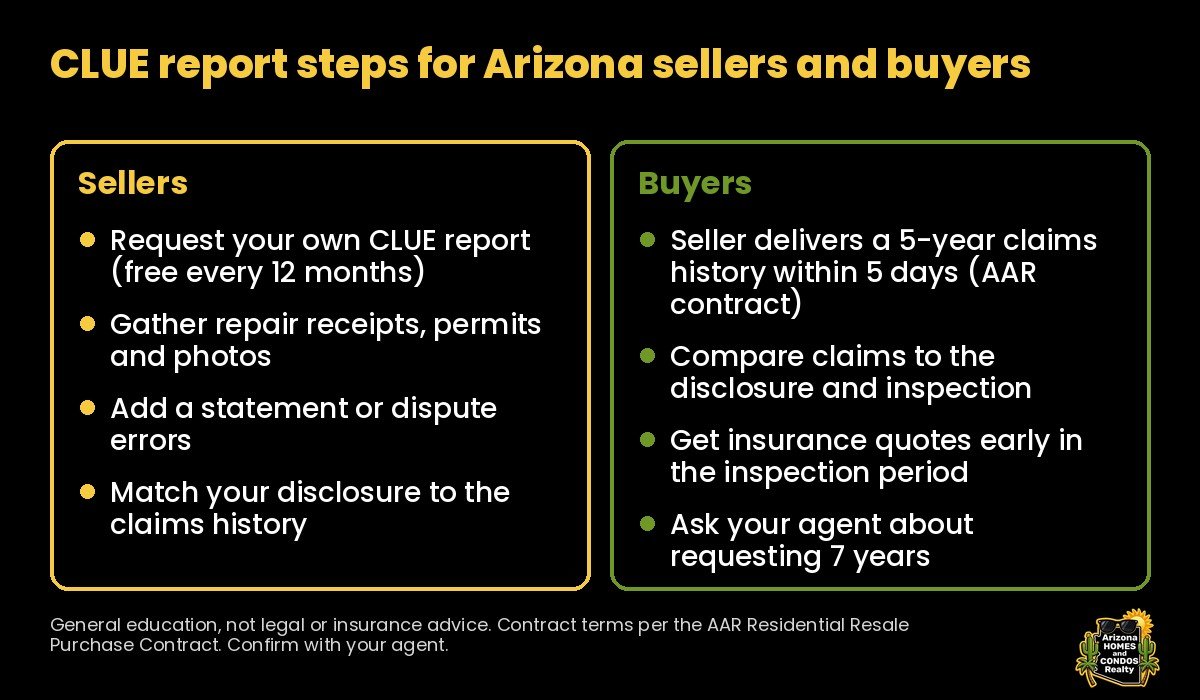
This one is already built into Arizona’s standard resale purchase contract. As the Arizona Association contract guide explains, the seller must deliver a written five-year insurance claims history within five days after contract acceptance, and the buyer can object during the inspection period or within five days of receiving it, whichever is later. If you want the full seven-year CLUE report, talk with your agent about asking for it in the contract terms.
What sellers should do with their CLUE report before listing
The best time to deal with your CLUE report is before a buyer’s insurer finds it. Here is what we walk sellers through:
- Request your own report from the LexisNexis consumer portal. It is free once every 12 months, and identity checks go by mail, so do it a few weeks early.
- Pull together proof for every claim: the repair invoice, the roofer’s or plumber’s receipt, any permit and photos of the finished work.
- Add a consumer statement to any entry that needs context, and dispute anything that is wrong. LexisNexis checks with the insurer that reported it.
- If there is a recent roof or water claim, consider a pre-listing roof or plumbing inspection so the first thing a buyer sees is the fix.
- Make your disclosure and your claims history tell the same story. Surprises late in escrow cost more than honest answers up front.
Thinking about selling? Start with a free estimate on our what is my Arizona home worth page, then see how our full-time listing agents prepare homes and condos for a clean closing.
What buyers should ask about the CLUE report during escrow
Buyers cannot order a home’s CLUE report themselves; the owner has to request it. That makes the purchase contract and your inspection period your best tools:
- Watch for the seller’s claims history within five days of acceptance, and read it line by line.
- Compare every claim to the seller’s disclosure and the inspection report. A past water or roof claim is a reason to ask for repair records and a closer look, not a reason to panic.
- Get homeowners insurance quotes in the first days of the inspection period, not the week of closing.
- If something does not add up, your agent can use the inspection notice to request repairs, records or a credit, or to cancel within your rights under the contract.
New to the process? Read our before you buy a home in Arizona checklist and our first-time home buyers in Arizona guide, or meet a dedicated full-time buyer’s agent.
Free CLUE report pre-listing checklist
Save this checklist or send it to anyone getting ready to sell an Arizona home or condo.
Free CLUE report and insurance pre-listing checklist
- Request your own CLUE report from LexisNexis (free once every 12 months) at least a few weeks before you list.
- Match every claim on it to a receipt, invoice, permit or photo that shows the repair was finished.
- Add a short consumer statement to any entry that needs context, and dispute anything that is wrong.
- If there is any roof or water claim, get a current roof or plumbing inspection so buyers see the fix.
- Make sure your Seller’s Property Disclosure Statement (SPDS) lines up with the claims history.
- Have your insurer’s claims history ready to deliver within 5 days of an accepted contract.
- Before you call about new damage, decide whether you are asking a question or filing a claim.
Want a second set of eyes? Talk to a full-time dedicated agent and we will review your claims history and disclosures with you before you list.
Why a full-time dedicated agent matters for your CLUE report
Nothing in this article is hard once you know it. The problem is timing. A part-time agent may not ask about the claims history until a buyer’s insurer raises it a few days before closing, when every option is expensive.
A full-time dedicated agent at Arizona Homes and Condos Realty asks about claims and repairs at the first listing meeting, lines up buyer insurance quotes during the inspection period and reads the disclosure, the inspection and the claims history side by side. That is how a $0 claim stays a footnote instead of a lost sale.
CLUE report FAQ
What is a CLUE report?
A CLUE report is a claims history report from LexisNexis that insurers use to price and underwrite policies. For homes it can show up to seven years of property claims, including the date, type of loss and amount paid, along with the property address and policy details.
Is a CLUE report tied to the house or the person?
Both. A home claim record includes the policyholder’s name and the property address, so an insurer can see claims linked to you and claims linked to the address, including claims made by a prior owner.
Can a claim that paid $0 show up on a CLUE report?
Yes. If you filed an actual claim and the insurer opened a file, investigated or denied it, it can be reported even when nothing was paid, for example when the damage was below your deductible.
Does asking my insurer a question count as a claim in Arizona?
No. Arizona law says an insurer cannot treat a question about whether a policy covers a loss as a claim, cannot use it to decline, cancel or nonrenew you, and cannot report a mere inquiry. It becomes a claim when you file one and the insurer investigates.
Can a buyer get the CLUE report on a home they want to buy?
Not directly. The owner must request a property’s CLUE report. In Arizona, the standard resale purchase contract requires the seller to deliver a five-year insurance claims history within five days after acceptance, and your agent can discuss asking for more.
How do I get my own CLUE report for free?
Request it from the LexisNexis consumer portal at consumer.risk.lexisnexis.com, online or by mail. You are entitled to one free report every 12 months, and the request is verified by mail, so start early.
This article is general education about insurance and real estate in Arizona, not legal or insurance advice. Laws and insurer practices change. Confirm your situation with a licensed insurance agent, and an attorney for legal questions.
Talk to a full-time dedicated agent
Buying or selling a home or condo in Arizona? Tell us where and when, and a full-time local agent will reply personally to help you plan around insurance, disclosures and claims history before they become a problem.
Talk to a full-time dedicated agent about your home’s claims history
Two quick steps. A full-time local agent replies personally.
Call Arizona Homes and Condos Realty at (480) 490-4865 or visit ArizonaHomesandCondos.com.