
Last Updated: October 2026

Before You Buy a Home in Arizona: 9 Things We’d Tell a Friend
Before you buy a home in Arizona, slow down long enough to picture the life you will live there, not just the house. These are the nine things we would tell a friend before they make an offer, and the same checks our dedicated full-time buyer’s agents walk through with every client.
Use it as your Arizona home buying checklist, whether you are a first time home buyer in Arizona or you have owned before. Buying a home in Arizona comes with a few desert surprises, and almost all of them are easier to catch before you make an offer than after.
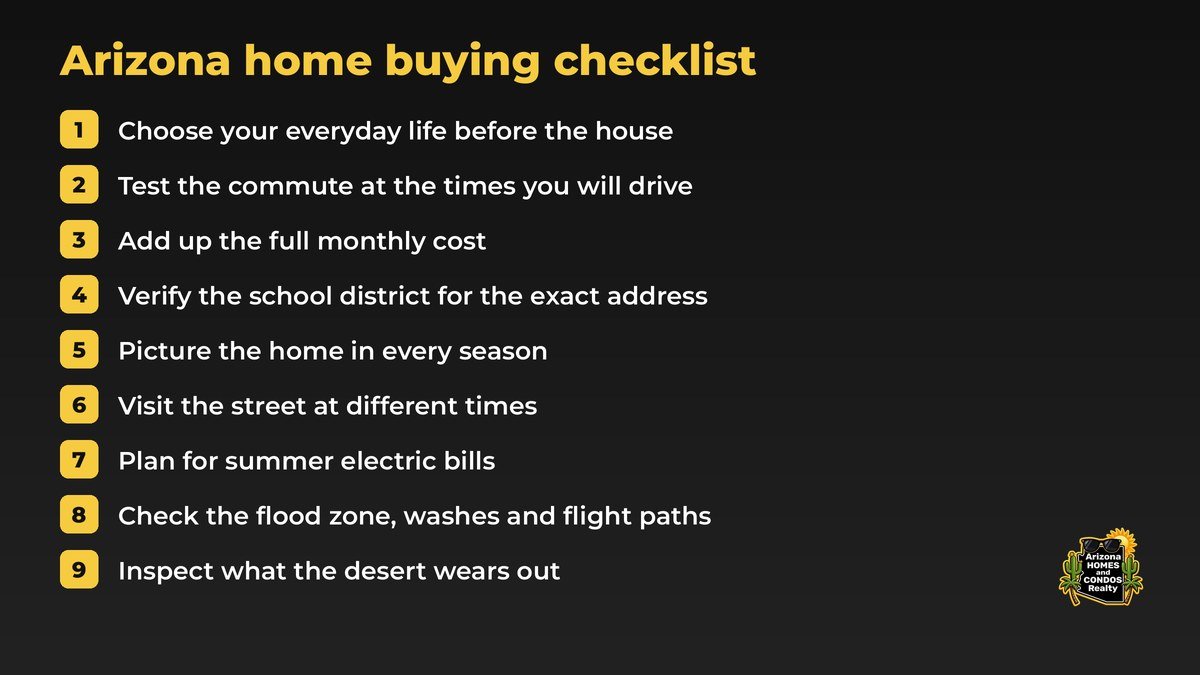
Your Arizona home buying checklist at a glance
- Choose your everyday life before the house.
- Test the commute at the times you will actually drive.
- Look at the full monthly cost.
- Verify the school district for the exact address.
- Picture the home in every season.
- Visit the street at different times.
- Plan for summer electric bills.
- Check the flood zone, washes and flight paths.
- Inspect what the desert wears out.
Jump to a section
1. Choose your everyday life before the house
Write down your three lifestyle priorities first. A beautiful kitchen cannot change the location.
It is easy to fall for new counters, a big great room or a resort-style backyard. Those things matter, but a kitchen can be remodeled. The house cannot be moved closer to the places you go every week.
Your three priorities might be a shorter drive to work, room for a garden, a walk to a park or trail, a single-story layout or space for a workshop. Keep the list on your phone and score every home against it before you score the finishes.
When two homes feel close, the one that fits your list is usually the one that still feels right a year after you move in.
2. Test the commute at the times you will actually drive
Drive it at rush hour, then time the trips to school, groceries, the gym and the people you visit most.
A route that feels quick on a Sunday afternoon can feel very different on a weekday morning. Map apps are a good start, but nothing replaces doing the drive yourself at the time you would really leave the house.
Try the return trip in the late afternoon too. On east and west roads, the low sun can sit right in your windshield on the drive home.
If you work from home, test the trips you make most instead: the grocery run, the drive to the gym or a weekly visit to the people you see most.
3. Look at the full monthly cost of buying a home in Arizona
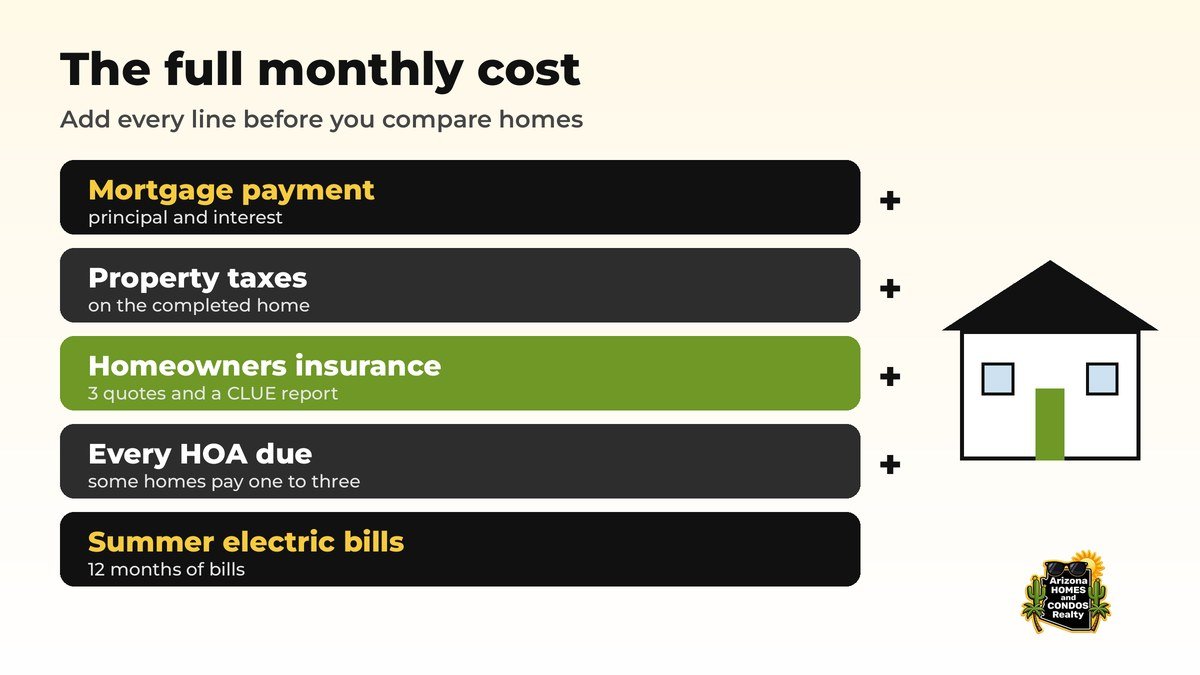
The mortgage payment is only part of the number. Add property taxes, homeowners insurance (have your agent request a CLUE claims history report on the home) and every HOA due, since some homes and condos pay one to three associations.
Get insurance quotes before you write the offer
Get 3 insurance quotes before you make an offer, because insurers check the property’s CLUE claims history and it can decide whether a policy is even bindable.
A CLUE report shows past insurance claims on the property, such as water or roof claims. Starting the quotes early means a surprise shows up while you still have choices, not a few days before closing.
Count every HOA due
Ask for the amount and billing schedule of every association that covers the home. A master association plus a separate community or condo association is common in planned communities. Ask too about any fees charged when the home changes hands, so the closing numbers hold no surprises.
Read the HOA rules as well as the dues. Parking, rentals, exterior paint, solar and backyard changes are often covered, and those rules shape everyday life as much as the fee does. Our guide to Arizona HOA rules and parking fines shows how a small rule can turn into a big bill.
New construction: taxes and the backyard
On new construction, ask whether the tax estimate reflects the completed home. A tax figure based on the bare lot or an unfinished home can be far lower than what you pay once the finished home is assessed.
Plan for a backyard that usually comes as dirt only, with no landscaping, patio or turf. A new construction agent checks both before you sign.
Put it all in one monthly number: principal and interest, taxes, insurance, HOA dues and an estimate for summer electric bills (point 7). That total, not the list price alone, is the real cost of buying a home in Arizona, and it is the number to compare between homes.
4. Verify the school district for the exact address
Boundaries follow the address, not the city name. Confirm the assigned schools for the street, then look them up on the Arizona Department of Education school report cards.
Many Arizona cities are served by more than one school district, and district lines do not always match city limits or ZIP codes. Two homes a few streets apart can be assigned to different schools.
Before you buy a home in Arizona, ask the district to confirm the assignment for the exact address, and check again before you remove contingencies, because boundaries and enrollment options can change. It matters at resale too, since future buyers will ask the same question.
5. Picture the home in every season
Check afternoon sun on the backyard with ShadeMap, and look at where water goes after a monsoon storm.
Most homes and condos get toured in mild weather. Before you buy a home in Arizona, ask yourself what the backyard, the patio and the front door will feel like on a July afternoon. ShadeMap lets you pick a date and time and see where shadows from the house, trees and nearby buildings fall.
A west-facing backyard takes the hottest late-day sun in summer, while a north-facing patio sits in the shade of the house for much of the day. Neither is wrong. It just changes how and when you will use the yard.
For monsoon season, walk the lot and look at how the ground slopes, where the downspouts and roof drains empty, and whether stains, erosion or debris lines show where water has pooled.
Look closer at the house itself too. Check the shade over the driveway and the spot where the AC unit sits, and notice which windows face west, since those rooms take the late-day heat.
6. Visit the street at different times
Go on a weekday morning, during the day, in the evening and on a weekend. Traffic, noise, parking and lighting all change.
A showing is one short visit at a time that suits the seller. Before you buy a home in Arizona, come back at the times you would be leaving for work, coming home and relaxing on a Saturday.
Notice the place itself: school-zone traffic, delivery trucks, a busy cut-through street, how full street parking gets at night, how well the streetlights cover the sidewalk, and sound from a nearby road, rail line or commercial area. Write it down as facts about the street, then decide what matters to you.
Check cell coverage inside and outside the home. Look up the address on the FCC National Broadband Map, which shows the mobile coverage providers report for outdoors and in vehicles, not indoors. Then make a call and load a page in every room, the garage and the backyard, and test again during your inspection period.
7. Plan for summer electric bills
Ask for twelve months of bills from APS, SRP or TEP, and find out whether any solar is owned or leased, because a lease transfers to you.
Which utility serves the home depends on the address. A full twelve months shows you an entire summer, when cooling costs peak in the desert. Usage habits differ from one owner to the next, so treat the bills as a guide rather than a promise.
Before you buy a home in Arizona with solar, ask for the paperwork. With a lease, ask for the agreement, the monthly payment and the remaining term before you commit. If the panels are owned but still being paid off, ask how that balance is handled at closing.
8. Check the flood zone, washes and flight paths
Look up the address on the FEMA Flood Map Service Center, then check your county flood control district map (in Maricopa County, that is the Flood Control District of Maricopa County), and note any wash near the lot. Check for any flight path near the home, and have your agent pull the official airport disclosure maps.
The FEMA Flood Map Service Center is the official public source for flood hazard information produced for the National Flood Insurance Program. If a home sits in a mapped high-risk flood zone, a mortgage can require flood insurance, which adds to your monthly cost.
Washes can stay dry for months and then run fast during a storm. Note where they are, how the street drains, and whether a low crossing on your daily route could close when water runs.
For flight paths, the disclosure maps are the starting point. Then use point 6: visit at different times of day and listen for yourself.
9. Inspect what the desert wears out
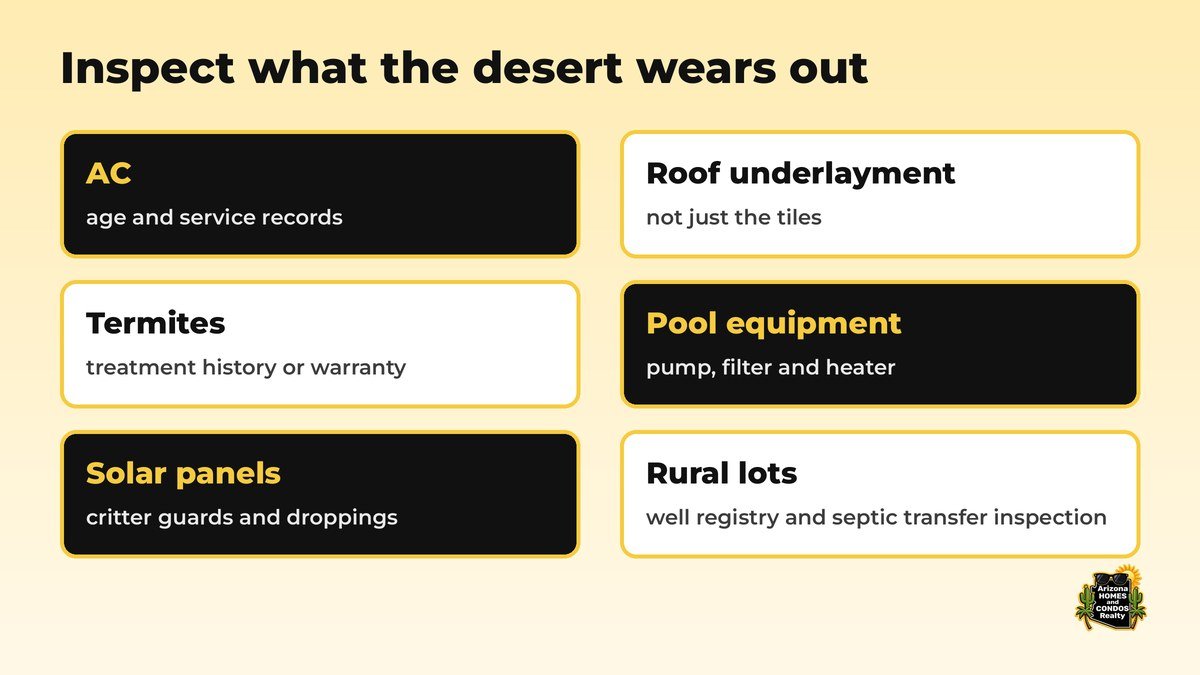
Before you buy a home in Arizona, ask about the age of the AC, the roof underlayment, termites and the pool equipment. On rural lots, also check the well in the Arizona Department of Water Resources well registry and the septic system under the ADEQ transfer inspection rules.
AC, roofs, termites and pools
Desert heat is hard on mechanical systems. Ask for the age and service records of the AC, and have your inspector look closely at it. On tile roofs, the tiles often outlast the underlayment beneath them, so ask about the underlayment, not just the tiles.
Ask whether the home has a termite treatment history or warranty, and read what the inspection says about termite activity. If there is a pool, have the pump, filter, heater and any automation checked.
Solar panels and critter guards
On homes and condos with solar panels, pigeons nesting under panels that have no critter guard (a mesh cage) can cause tens of thousands of dollars in roof damage. Look for critter guards and droppings, and ask your inspector to look under the panels.
Our guide to pigeon damage on Arizona roofs and solar panels shows what that damage looks like and what to ask about.
Rural lots: wells and septic
Wells are registered to the parcel where they are physically located, and you can search the Arizona Department of Water Resources registry by parcel number. Ask for the well registration and any recent well or water test records.
For septic, Arizona’s statewide program is triggered by resale. The seller hires a certified inspector for a transfer of ownership inspection within six months before the transfer, and the buyer submits a Notice of Transfer within 15 calendar days after the property transfers.
Extra tips for a first time home buyer in Arizona
If you are a first time home buyer in Arizona, nine checks can feel like a lot. Here is the order we suggest for working through this Arizona home buying checklist.
- Do points 1 and 2 before you tour. Your priorities and your commute decide which homes and condos are worth seeing.
- Talk with a loan officer early, so the monthly cost math in point 3 uses real numbers.
- Start insurance quotes as soon as you are serious about a home.
- Use your inspection period for points 7, 8 and 9: the bills, the flood maps, the inspection and, on rural lots, the well and septic.
- Read the seller’s disclosure, the HOA documents and every report as soon as you get them, while you still have time to ask questions.
- Keep a simple notes page for each home, with your three priorities at the top.
Every first time home buyer in Arizona we work with gets the same list, and so does every move-up buyer. It works because it keeps the focus on everyday life, not just the showing.
Before you buy a home in Arizona: frequently asked questions
What is the most important thing to do before you buy a home in Arizona?
Decide on your everyday life first. Write down your three lifestyle priorities, test the commute at the times you will really drive, and add up the full monthly cost. A beautiful kitchen cannot change the location.
What belongs on an Arizona home buying checklist?
Our Arizona home buying checklist has nine checks: your everyday priorities, the commute, the full monthly cost, the school district for the exact address, the home in every season, the street at different times, summer electric bills, the flood zone, washes and flight paths, and an inspection of what the desert wears out.
Why should a first time home buyer in Arizona get insurance quotes before making an offer?
Insurers check the property’s CLUE claims history, and it can decide whether a policy is even bindable. Getting 3 quotes before you make an offer gives you time to adjust if a home turns out to be hard to insure.
What happens to leased solar panels when you buy the home?
A solar lease transfers to you. Ask for the agreement, the monthly payment and the remaining term before you commit. If the panels are owned, ask whether any balance is still owed on them and how it is handled at closing.
How do I check the flood zone for an Arizona address?
Look up the address on the FEMA Flood Map Service Center, then check your county flood control district map, and note any wash near the lot.
What should I check on a rural lot when buying a home in Arizona?
Look up the well in the Arizona Department of Water Resources well registry, and confirm the septic system has had the transfer of ownership inspection that ADEQ requires when a home is sold.
Ready to start buying a home in Arizona?
Think about an ordinary Tuesday, not just the day you fall in love with the house. When you are ready, talk with a dedicated full-time local agent who works only for you.
Ready to start your home search?
Two quick steps. A full-time Arizona agent replies personally.