
How to Check a Home’s Sun and Shade Before You Buy in Arizona (Free ShadeMap Tool)
Last Updated: October 2026
In Arizona, sun and shade can make or break a backyard. Before you buy, you can see exactly where the sun hits any home, on any date and at any hour, with a free online tool called ShadeMap.
This guide walks through it step by step: how to read the sun exposure on a backyard, patio, pool and driveway, and what a north-facing backyard really means in an Arizona summer. Use it on every home you tour, then bring your notes to a dedicated full-time buyer’s agent so the lot gets the same attention as the kitchen.
Why sun and shade matter more in Arizona
The National Weather Service office in Phoenix calls heat the deadliest weather in Arizona on its NWS Phoenix heat page. That makes the shade around a home much more than a comfort detail.
Shade decides whether you can use the patio on a summer afternoon, how hot the car is when you leave for work, and how hard the air conditioner runs all summer long.
The U.S. Department of Energy’s Consumer Guide to Home Landscaping notes that simply providing shade for an air conditioner can increase its efficiency by as much as 10%. It also says trees with low branches are best planted on the west side of a house, where shade from the afternoon sun is needed.
Those ideas matter when you compare homes, because the lot you buy decides where shade can grow. Two homes with the same floor plan on the same street can live very differently when one backyard faces north and the other faces west. Listing photos rarely show that. A quick sun and shade check does.
How to check sun and shade with ShadeMap, step by step
ShadeMap is a free web map that simulates the shadows cast by buildings, terrain and, where its map data has them, trees, for any place on Earth at any date and time. There is nothing to install. It runs in the browser on your phone or computer.
Step 1: Search the address
Open the map and type the home’s address or the subdivision name into the search box. Zoom in until you can see the house, the backyard and the homes and condos around it.
If a satellite or aerial view is offered, switch to it. It makes the pool, the patio cover and the driveway much easier to spot.
Step 2: Pick a date, late June vs late December
Shade changes with the seasons, so set the date to the two extremes. Late June shows the summer sun near its highest path of the year. Late December shows the winter sun near its lowest.
If you only have time for one date, choose summer. That is when shade matters most in the desert.
Step 3: Drag the time slider
Move the time slider slowly from sunrise to sunset and watch the shadows swing across the lot. Pause at the hours you would actually use each space: morning coffee on the patio, an evening swim, or the time you usually pull into the garage.
Arizona stays on standard time all year, outside the Navajo Nation, so a 5 p.m. check in June and a 5 p.m. check in December are on the same clock. There is no daylight saving shift to adjust for.
Step 4: Read the shade on the backyard, patio, pool and driveway
Dark areas on the map are in shadow and bright areas are in direct sun. Note when the house starts to shade the patio, whether the pool sits in full afternoon sun, and whether the driveway and garage door take the late-day heat.
Take a screenshot at each key hour. Later you can line up two or three homes side by side and compare them hour by hour.
Step 5: Compare the map with what you see at the showing
The map is a model, not a photo. Tree data can be incomplete, patio covers and shade sails may not appear, and a new two-story home can go up on an empty lot next door. Use the map before the showing to know what to look for, then confirm the real sun exposure in person.
Sun exposure by home orientation
Orientation is simply the direction the back of the house faces. Stand on the patio facing out and open the compass app on your phone. It tells you in seconds.
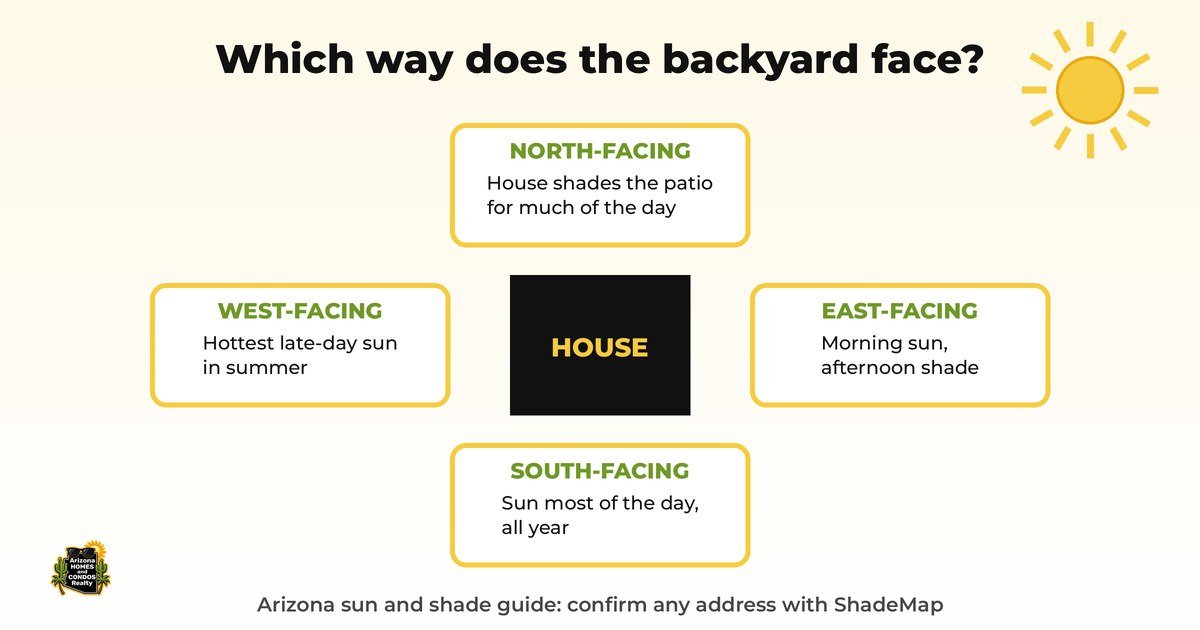
Here is how each direction usually plays out in Arizona. Treat these as rules of thumb, then check the actual lot on the map.
North-facing backyard
A north-facing backyard is the classic Arizona favorite, because the house itself shades the patio for much of the day. In late June, though, the sun rises north of due east and sets north of due west, so the yard can still catch early morning and evening sun.
In winter the house casts a long shadow across a north-facing backyard. The area near the house can stay cool and slow to dry after a rain, and some plants may struggle there.
South-facing backyard
A south-facing backyard gets sun for most of the day in every season. That can feel great in winter, warm the pool on cool days and help a garden.
It also means the patio needs a deep cover, shade sails or trees to be comfortable on summer afternoons.
East-facing backyard
An east-facing backyard gets the morning sun, then falls into the shade of the house in the afternoon, when the day is hottest. Many buyers see it as a practical middle ground.
The front of the home then faces west, so check how hot the driveway, the garage and the front door get late in the day.
West-facing backyard
A west-facing backyard faces the afternoon and evening sun, the hottest stretch of a summer day. It can still work well with an extended patio cover, mature trees or shade screens, and it often comes with sunset views.
Just budget for the shade you may need to add, and look closely at the summer electric bills.
Front orientation, windows and the garage
The front matters too. A west-facing garage and driveway take the late-day sun, so the garage and any car parked outside can be much warmer in the evening.
Large west-facing windows can heat up a room unless they have good sunscreens or window coverings. Note what is already installed and what you would add.
Summer vs winter sun angles in Arizona
The sun’s path across the sky changes a lot between summer and winter. Around late June the midday sun climbs close to overhead in Arizona, so shadows are short. Around late December the sun stays much lower in the southern sky, so shadows stretch long toward the north.
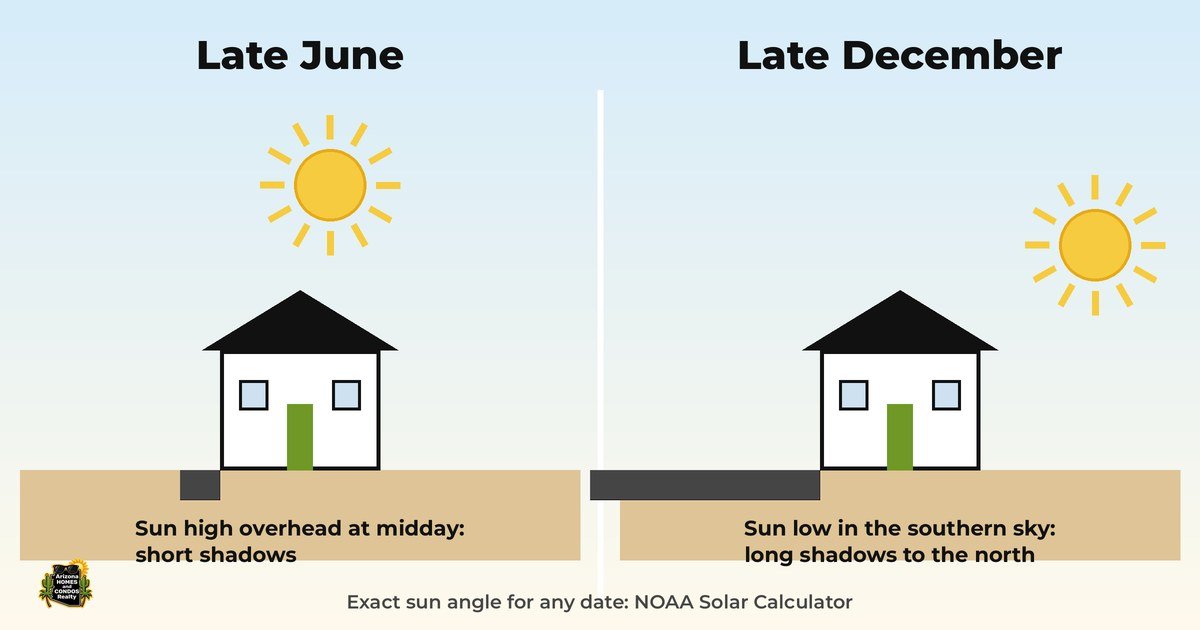
That is why a patio that looks shaded during a winter showing can sit in full sun in July. It is also why a yard that feels cool in December can be bright and hot by June.
If you tour homes and condos between November and February, always run the summer date on the map before you make an offer.
Want the exact numbers for one address? The NOAA Solar Calculator from the National Oceanic and Atmospheric Administration gives the sun’s elevation, its compass direction (azimuth), sunrise, sunset and solar noon for any location and date. Pair it with the shadow map and you have both the angle and the shade it creates.
Plan a shadier hike with the trail shade profile
The same idea works when you head out for a hike. The trail shade profile shows when and where a trail is shaded from the sun by mountains, valley walls or buildings. Because the sun’s position changes through the year, each profile is unique to the date you choose.
To use it, open the shade profile page, add your trail route, pick the date of your hike and read the profile to see which stretches are in sun at each time of day. A short video tutorial on the page walks you through it.
The tool notes that shade profiles do not include shade from trees yet, so treat it as a guide to canyon and mountain shade. In the desert, that can help you choose a start time when more of the climb sits in shadow. Check the NWS Phoenix heat guidance before any summer hike, too.
Sun and shade checklist for your next showing
Bring this list to every tour. It takes a few minutes per home and answers the sun exposure questions that photos can’t.
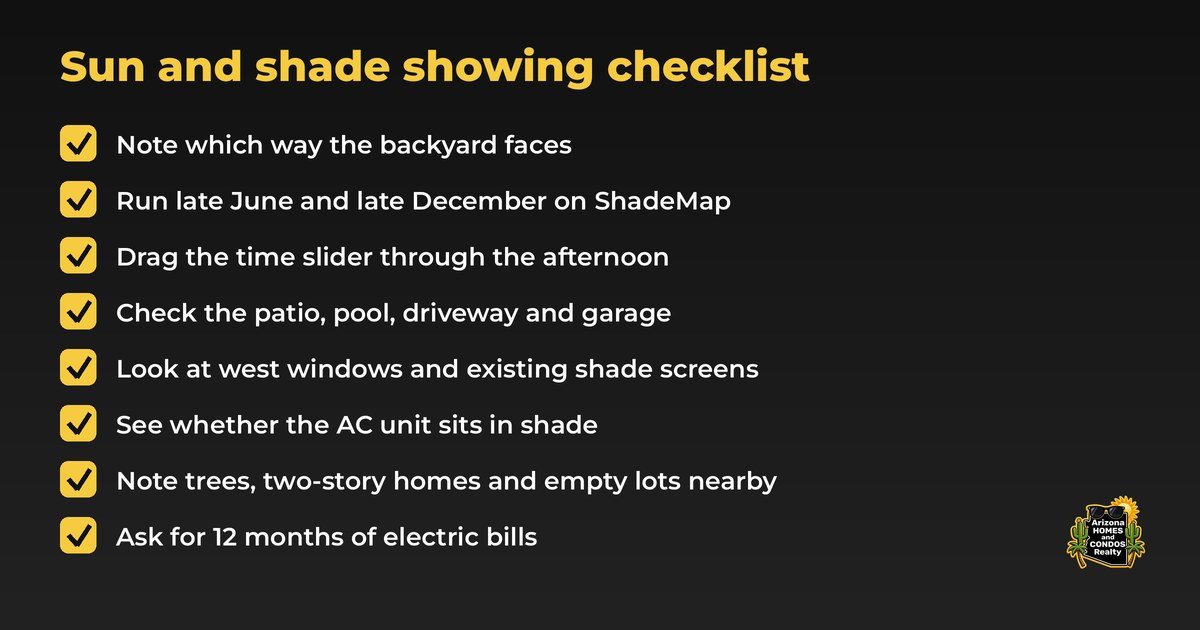
- Note which way the backyard faces, using the compass on your phone.
- Run the address for late June and late December on the map.
- Drag the time slider through the afternoon and note when the patio falls into shade.
- Check the patio, pool, driveway and garage at the hours you would use them.
- Look at west-facing windows and any existing shade screens or coverings.
- See whether the AC unit sits in shade, since shade can help it run more efficiently.
- Note trees, two-story homes and empty lots nearby that could change the shade later.
- Ask for 12 months of electric bills to see what summer cooling really costs.
Keep your screenshots and notes in one folder per home. When it is time to compare homes and write an offer, you will have the patio, pool and driveway hours side by side instead of relying on memory.
If the home has solar panels, or you plan to add them, also check whether nearby trees or taller homes and condos shade the roof in the middle of the day. Your home inspector can look at the panels and the roof up close.
What a sun exposure check can’t tell you
A shadow map shows the buildings and terrain in its data today. It can’t predict a home that has not been built yet, a tree a neighbor plants next spring, or a patio cover you add later.
New construction needs extra care. A new lot is often bare dirt with no trees, so the map shows only house shadows. Ask which way each available lot faces before you choose one. Our Arizona new construction agent page explains how we help, and our new construction subdivisions in Arizona hub lists communities across the state.
In a condo or townhome, the direction of the balcony or patio and the buildings around it decide how much sun each unit gets. Our Arizona condo agent page covers what else to check before you write an offer.
Ways to add shade after you buy
If you love a home but the backyard runs hot, shade can often be added. Price out the common options before you write an offer, so the cost is part of your decision and not a surprise after closing.
- Extend or deepen the patio cover so the seating area stays covered later into the afternoon.
- Add shade sails or a pergola over the pool deck or an outdoor dining area.
- Plant trees where shade is needed. The DOE landscaping guide recommends tall trees with high, spreading branches on the south side for summer roof shade, and lower-branching trees on the west side for afternoon shade.
- Install exterior sunscreens on west- and south-facing windows.
- Shade the AC unit while keeping the clearance its manufacturer requires.
Trees take time to grow, so they are a long-term fix. The same DOE guide notes that air temperatures directly under trees can be 25°F cooler than the air above a nearby blacktop parking lot, which is a good reminder of how much a mature canopy can help.
Ask for quotes from licensed local contractors and check your HOA’s approval process first. A patio cover or shade structure may also need a city permit, so confirm with the city or town before you build.
Where to start your Arizona home search
Every Arizona city gets strong sun, but lots, floor plans and street layouts vary from one subdivision to the next. Our city market reports are updated monthly. Start with any of these, then run each home you like through the steps above:
- Mesa real estate market report
- Phoenix real estate market report
- Scottsdale real estate market report
- Gilbert real estate market report
- Chandler real estate market report
- Queen Creek real estate market report
- Surprise real estate market report
- Buckeye real estate market report
Tell us which cities you are considering and how you like to use a yard, and we can flag homes and condos worth a closer look before you spend a weekend touring.
Frequently asked questions
Is a north-facing backyard better in Arizona?
Many buyers prefer a north-facing backyard because the house shades the patio for much of the day in summer. It can still get early and late sun around late June, and it stays shadier in winter. The best direction depends on how you plan to use the yard, so check the actual lot.
What dates should I check?
Check late June for the high summer sun and late December for the low winter sun. Those two dates show the full range of sun and shade a lot sees in a year.
Do I need to install anything?
No. The map runs in a web browser on a phone or computer. Search the address, set the date and drag the time slider.
Does the map show shade from trees?
Trees appear only where the underlying map data includes them, and the trail shade profile does not include trees yet. Always confirm tree shade in person at the showing.
Get help checking your next home
Think about an ordinary July afternoon, not just the day you fall in love with the house. A dedicated full-time local agent can walk the lot with you, run these checks on every home you tour and point out the details that photos leave out.
Get started with a dedicated full-time agent
Two quick steps. A full-time local agent replies personally.
Call Arizona Homes and Condos Realty at (480) 490-4865 or visit ArizonaHomesandCondos.com.